svcorelib
Version:
Core library used in the projects of Sv443 and the Sv443 Network. Contains tons of miscellaneous QoL features.
970 lines (850 loc) • 64.7 kB
TypeScript
/*
TypeScript Type Declaration file
Original declarations made by @canarado
>> If you came here looking for the source code, you're in the wrong file!
>> See the file `SvCoreLib.js` instead, it acts as a proxy to all of SCLs features.
>> From there, you can follow the file paths.
>> This file is responsible for the In-IDE documentation and explicit types (usually seen by pressing CTRL+Space or hovering over stuff)
*/
import { EventEmitter } from "events";
import { ServerResponse, IncomingMessage } from "http";
import { Connection, QueryOptions } from "mysql";
import { SelectionMenuSettings, SelectionMenuResult, SelectionMenuLocale, SelectionMenuOption } from "./src/types/SelectionMenu";
//#MARKER types
/**
* Describes an object that is JSON-compatible, aka doesn't contain self- / circular references or non-primitive JS properties
* [Source](https://github.com/microsoft/TypeScript/issues/1897#issuecomment-338650717)
*/
export type JSONCompatible = boolean | number | string | null | JSONArray | JSONMap;
interface JSONMap { [key: string]: JSONCompatible; }
interface JSONArray extends Array<JSONCompatible> {}
/** Describes a value that either is a string itself or has a `.toString()` method, meaning it can be converted to a string */
export type Stringifiable = string | {
toString(): string;
}
/** Describes any class reference that is constructable/newable */
export type Newable<T> = { new(...args: any[]): T; };
/** Describes any value that is a constructable/newable class reference or a function (ES5 classes and abstract ES6 classes) */
export type AnyClass<T> = Newable<T> | (Function & { prototype: T });
/**
* 
*
* ### SvCoreLib
* Core Library used in the projects of Sv443 and the Sv443 Network. Contains tons of miscellaneous QoL features
*
* ---
*
* **[Documentation](https://github.com/Sv443-Network/SvCoreLib/blob/master/docs.md#readme) • [GitHub Repo](https://github.com/Sv443-Network/SvCoreLib) • [Changelog](https://github.com/Sv443-Network/SvCoreLib/blob/master/changelog.md#readme) • [Discord](https://dc.sv443.net)**
*
* ---
*
* If you like this library please consider [supporting me ❤](https://github.com/sponsors/Sv443)
* @author [Sv443](https://github.com/Sv443)
* @copyright © 2020 Sv443 Network
* @license [MIT](https://sv443.net/LICENSE)
* @module svcorelib
*/
declare module "svcorelib" {
//#MARKER functions
//#SECTION Miscellaneous
/**
* 🔹 Returns true, if the input is undefined, null, an empty string, an empty array or an object with length = 0.
* Otherwise returns false. The number 0 and NaN will return false though, so check them independently if needed! 🔹
* @param input Variable that should be checked - this can be of any type but the basic types will work best
* @returns true, if empty or false, if not
* @since 1.4.0
* @version 1.6.5 lowercase alias scl.isempty was removed
* @version 1.8.0 Added check for objects with length = 0
* @version 1.13.0 Fixed TypeError when input is `null`
*/
function isEmpty<T>(input: T): boolean;
/**
* 🔹 Checks how many values of the array are empty (does the same check as `scl.isEmpty()`, but on each array item) 🔹
* @param array Array that should be checked
* @returns true if all are empty, false if none are empty and number if only some are empty
* @throws Throws an error if the parameter isn't an array
* @since 1.5.0
* @version 1.8.0 Throwing error now instead of returning string
*/
function isArrayEmpty<T>(array: T[]): boolean | number;
/**
* 🔹 Checks if the passed value is a reference to a class 🔹
* @param val Value to check
* @since 1.17.0
*/
function isClass<T>(val: any): val is AnyClass<T>;
/**
* 🔹 Sends a red console message and optionally exits the process with an optional status code. 🔹
* @param cause The cause of the error
* @param log_file_path if the error message should automatically be logged to the file with the specified path. undefined or null to disable.
* @param shutdown if the process should be exited or not
* @param status with which status code the process should be exited
* @param consoleMsg whether to show a red message in the console or not
* @throws Throws an error if the "cause" parameter isn't a string
* @since 1.5.0
* @version 1.8.0 Throwing error now instead of logging to console and returning undefined
*/
function error(cause: string, log_file_path?: string, shutdown?: boolean, status?: number, consoleMsg?: boolean): void;
/**
* 🔹 Tests an array and returns true if all values are equal. 🔹
* @param array The array you want to test
* @param loose Set to `true` to use loose equality comparison instead of strict equality comparison. Defaults to `false`
* @returns true if all values are equal, false if not
* @throws Throws an error if the parameter is not an array
* @since 1.5.0
* @version 1.8.0 Throwing error now instead of returning string
*/
function allEqual<T>(array: T[], loose?: boolean): boolean;
type JSPrimitiveTypeName = "bigint" | "boolean" | "function" | "number" | "object" | "string" | "symbol" | "undefined";
/**
* 🔹 Tests if all items of an array are of the specified type. 🔹
* @param array The array you want to test
* @param type The type you want to test the array's items on
* @returns true if all items are of the specified type, false if not
* @throws Throws a TypeError if the first parameter is not an array or if the second parameter is not a valid primitive data type name
* @since 1.11.0
*/
function allOfType<T>(array: T[], type: JSPrimitiveTypeName): boolean;
/**
* 🔹 Checks if each item of an array is an instance of the passed class reference. 🔹
* @param array Array that should be checked
* @param Class Reference to the class to be checked. Don't pass an actual instance of that class!
* @returns Returns true if all items are an instance of `Class`, else returns false
* @throws Throws a TypeError if the parameters are invalid
* @since 1.17.0
*/
function allInstanceOf<T>(array: T[], Class: AnyClass<T>): boolean;
/**
* 🔹 Reserializes a JSON-compatible object. This means it copies the value of an object and loses the internal reference to it.
* Using an object that contains special JavaScript classes or circular objects will throw an error. 🔹
* @param obj The object you want to reserialize - if this is not of type `object`, you will just get the original value back
* @param immutable Set this to `true` if you want to make the returned object immutable (its properties can't be modified anymore)
* @returns Returns the reserialized object or the unmodified original value if it is not of type `object`
* @since 1.10.0
*/
function reserialize<O extends JSONCompatible, I extends boolean>(obj: O, immutable?: I): I extends true ? Readonly<O> : O;
/**
* 🔹 Splits an array into a certain amount of parts 🔹
* @param array The array to split
* @param partsAmt Into how many parts the array should be split
* @param balanced Default (false): returned parts all have the same length except the last one. (true): returned parts are equally balanced and have similar lengths.
* @since 1.18.0
*/
function splitIntoParts<T>(array: T[], partsAmt: number, balanced?: boolean): T[][];
/**
* 🔹 Splits an array into any number of parts with a max length. 🔹
* @param array The array to split
* @param maxLength The maximum length of each part. Has to be at least 1 or higher.
* @since 1.18.0
*/
function splitIntoPartsOfLength<T>(array: T[], maxLength: number): T[][];
type ParseDurationResult = Record<"days" | "hrs" | "mins" | "secs" | "ms", number>;
/**
* 🔹 Parses a duration in milliseconds into the larger units; days, hours, minutes, seconds and milliseconds 🔹
* @param millis The duration in milliseconds
* @throws Throws a TypeError if `millis` is not a number or less than 0
* @since 1.15.0
*/
function parseDuration(millis: number): ParseDurationResult;
/**
* 🔹 Formats a duration in milliseconds to a human-friendly string, according to a provided format 🔹
* @param millis The duration in milliseconds
* @param format The format of the duration. Use the following placeholders: `%d` for days, `%h` for hours, `%m` for minutes, `%s` for seconds and `%ms` for milliseconds
* @param leadingZeroes Whether to pad the numbers with leading zero(es). Defaults to true
* @throws Throws a TypeError if the parameters are invalid or `millis` is less than 0
* @since 1.15.0
*/
function formatDuration(millis: number, format: string, leadingZeroes?: boolean): string;
/**
* 🔹 Converts an array to a better readable one 🔹
* @param array The array you want to make readable
* @param separators The default separator for all values except the last one. Defaults to `, ` if left empty. Add whitespaces if needed!
* @param lastSeparator The last separator. Defaults to ` and ` if empty. Add whitespaces if needed!
* @returns Better readable array as string
* @since 1.7.0
*/
function readableArray(array: (string | Stringifiable)[], separators?: string, lastSeparator?: string): string;
/**
* 🔹 Transforms the `value` parameter, which is inside the numerical range [`range_1_min`-`range_1_max`] to where it would be on the numerical range [`range_2_min`-`range_2_max`] 🔹
* @param value The value from the first numerical range, that you want to transform to a value inside the second numerical range
* @param range_1_min lowest possible value of the **first** numerical range
* @param range_1_max highest possible value of the **first** numerical range
* @param range_2_min lowest possible value of the **second** numerical range
* @param range_2_max highest possible value of the **second** numerical range
* @returns Floating point number of `value` inside the second numerical range
* @throws Throws an error if the arguments are not of type `Number` or the `*_max` argument(s) is/are equal to 0
* @since 1.8.0
*/
function mapRange(value: number, range_1_min: number, range_1_max: number, range_2_min: number, range_2_max: number): number;
/**
* 🔹 Use this if you are using a linter that complains about unused vars.
* As this function basically does nothing, you can even leave it in once the variable is used again and nothing will break. 🔹
* @param variables Any amount of variable(s) of any type
* @since 1.8.0
* @version 1.9.0 Function now accepts an infinite number of parameters
*/
function unused(...variables: any): void;
/**
* 🔹 Replaces a character from the specified `string` at the specified `index` with the value of `replacement` 🔹
* @param input The input string
* @param index The zero-based index of the char you want to replace
* @param replacement What you want the char to be replaced with
* @since 1.8.0
*/
function replaceAt(input: string, index: number, replacement: string): string;
/**
* 🔹 Returns the length of a string in bytes.
* Passing anything other than a string will return `-1` 🔹
* @param str
* @since 1.10.0
*/
function byteLength(str: string): number;
/**
* 🔹 Returns both halves of an array as a tuple. 🔹
* @param array An array of any size, with any values contained inside
* @returns Returns a tuple with two array entries, being the first and second half of the array
* @since 1.15.0
* @example ```js
* const [first, second] = halves([ 1, 2, 3, 4, 5 ]);
*
* console.log(first); // [ 1, 2, 3 ]
* console.log(second); // [ 4, 5 ]
* ```
*/
function halves<T>(array: T[]): [first: T[], second: T[]];
/**
* 🔹 Inserts values into a percent-formatted string.
* If there are no insertion marks, this function returns the unmodified input string. 🔹
* @param str A string containing numbered insertion marks (%1, %2, ..., %10, %11, ...)
* @param values [Rest parameter] The values to insert into the string - All values that are not of type `string` will be attempted to be converted using their method `.toString()`
* @throws Throws a "TypeError" if the parameter `str` is not a string or if one of the values could not be converted to a string
* @since 1.12.0
*/
function insertValues(str: string, ...values: (string | Stringifiable)[]): string;
//#SECTION randomization
/**
* 🔹 Random number generator with upper and lower boundary. 🔹
*
* ❗ Warning! This RNG is not cryptographically secure, so don't do any password hashing or stuff that needs to be highly secure with this function!
* @param min Lower boundary of the RNG
* @param max Upper boundary of the RNG
* @throws Throws a TypeError if the arguments are not of type `number`
* @since 1.5.0
*/
function randRange(min: number, max: number): number;
/**
* 🔹 Random number generator with upper boundary.
* This overload automatically sets the lower boundary to 0. 🔹
*
* ❗ Warning! This RNG is not cryptographically secure, so don't do any password hashing or stuff that needs to be highly secure with this function!
* @param max Upper boundary of the RNG - using this overload will set the lower boundary to 0
* @throws Throws a TypeError if the arguments are not of type `number`
* @since 1.14.0
* @version 1.16.0 No longer depending on the `performance` module
*/
function randRange(max: number): number;
/**
* 🔹 Makes sure the provided `num` is always in between `min` and `max` 🔹
* @param num The number to clamp between `min` and `max`
* @param min Lower boundary
* @param max Upper boundary
* @throws Throws a TypeError if the parameters are not of type `number` or are NaN
* @since 1.16.0
*/
function clamp(num: number, min: number, max: number): number;
/**
* 🔹 Randomizes all items in an array and returns it 🔹
* @param array The array that should be randomized
* @returns Returns the randomized array
* @throws Throws an error if the parameter is not an array
* @since 1.8.0
*/
function randomizeArray<T>(array: T[]): T[];
/**
* 🔹 Chooses a random item in an array and returns it 🔹
* @param array An array of any size, with any values contained inside
* @returns Returns a random item of the provided array. **Returns undefined if the array is empty.**
* @since 1.9.4
*/
function randomItem<T>(array: T[]): T;
/**
* 🔹 Chooses a random item in an array and returns it, along with its index in the array. 🔹
* @param array An array of any size, with any values contained inside
* @returns Returns a tuple array with two entries. First entry is the randomly chosen item, second entry is the index of the random item. **Both entries are undefined if the array is empty.**
* @since 1.17.0
*/
function randomItemIndex<T>(array: T[]): [item: T, index: number];
/**
* 🔹 Chooses a random item in an array and returns it. Mutates the original array so the chosen item is no longer contained! 🔹
* @param array An array of any size, with any values contained inside
* @returns Returns the randomly chosen item. **Returns undefined if the array is empty.**
* @since 1.17.0
*/
function takeRandomItem<T>(array: T[]): T;
/**
* 🔹 Removes duplicate items in an array 🔹
* @param array An array with any values
* @since 1.9.0
*/
function removeDuplicates<T>(array: T[]): T[];
/**
* 🔸 Offers a few functions to generate seeded random numbers.
* This means using the same input seed, you will always get the same output number, just like you get the same Minecraft world when using the same seed twice. 🔸
*/
namespace seededRNG {
/**
* Represents a seed to be used in functions of the `seededRNG` namespace.
* Note that seeds can't start with the number `0` as they need to be compatible with both `string` and `number` types
*/
type Seed = (number | string);
/**
* Describes a set of numbers generated or needed by functions of the `seededRNG` namespace
*/
interface SeededRandomNumbers
{
[key: string]: number[] | string | number;
/** An array of the random numbers */
numbers: number[];
/** The random numbers, but as a string */
stringified: string;
/** The random numbers, but as an integer */
integer: number;
/** The seed that was used to create the random numbers */
seed: number;
}
/**
* 🔹 Generates random numbers from the numerical range [0-9] based on a seed.
* To make sure the seed is valid, you can use the function `validateSeed()`. 🔹
* @param count How many random numbers should be generated - will default to 16 if left empty
* @param seed The seed to generate numbers from. Leave empty to use a random default seed. The used seed will be included in the returned object
* @returns An object containing the seed and the random number in three different formats
* @since 1.8.0
*/
function generateNumbers(count?: number, seed?: Seed): SeededRandomNumbers;
/**
* 🔹 Creates a random seed 🔹
* @param digitCount How many digits the seed should have - defaults to 10 if left empty
* @since 1.8.0
*/
function randomSeed(digitCount?: number): number;
/**
* 🔹 Validates a seed to be used in `generateSeededNumbers()` 🔹
* @param seed The seed to validate - accepts string or number (also accepts octal and hexadecimal notation)
* @since 1.8.0
*/
function validateSeed(seed: Seed): boolean;
}
/**
* 🔸 Offers many functions to generate Universally Unique Identifiers (UUIDs) 🔸
*/
namespace uuid {
/**
* 🔹 Creates an alphanumerical [0-9,A-Z] UUID with a given format. This uses a RNG that is even more random than the standard Math.random() 🔹
* @param uuidFormat The format of the UUID. All x's and y's will be affected by the RNG. Example: "xxxx-yyyy-xxxx-yyyy" - if you want an x or y to not be replaced, escape (prefix) it with this character: `^`
* @param upperCase Set to true to have all letters in upper case, false for lower case
* @since 1.8.0
*/
function alphanumerical(uuidFormat: string, upperCase?: boolean): string;
/**
* 🔹 Creates a binary [0-1] UUID with a given format. This uses a RNG that is even more random than the standard Math.random() 🔹
* @param uuidFormat The format of the UUID. All x's and y's will be affected by the RNG. Example: "xxxx-yyyy-xxxx-yyyy" - if you want an x or y to not be replaced, escape (prefix) it with this character: `^`
* @param asBooleanArray Set to true to get an array of booleans instead of a string of 1 and 0. Setting this to true will ignore the uuidFormat parameter. Instead, the amount of x's and y's will be equivalent to the resulting array items.
* @since 1.8.0
*/
function binary(uuidFormat: string, asBooleanArray?: boolean): string | boolean[];
/**
* ❌ Warning: This overload is deprecated! Please use the other one. ❌
*
* 🔹 Creates a custom UUID with a given format from a list of characters specified by the possibleValues parameter. This uses a RNG that is even more random than the standard Math.random() 🔹
* @param uuidFormat The format of the UUID. All x's and y's will be affected by the RNG. Example: "xxxx-yyyy-xxxx-yyyy" - if you want an x or y to not be replaced, escape (prefix) it with this character: `^`
* @param possibleValues A string containing all characters that can be injected into the final UUID - (delimited by nothing) - Example: "ABCDEF01234$%&#"
* @since 1.8.0
* @deprecated
*/
function custom(uuidFormat: string, possibleValues: string): string;
/**
* 🔹 Creates a custom UUID with a given format from a list of characters specified by the possibleValues parameter. This uses a RNG that is even more random than the standard Math.random() 🔹
* @param uuidFormat The format of the UUID. All x's and y's will be affected by the RNG. Example: "xxxx-yyyy-xxxx-yyyy" - if you want an x or y to not be replaced, escape (prefix) it with this character: `^`
* @param possibleValues An array containing all characters that can be injected into the final UUID
* @since 1.14.0
*/
function custom(uuidFormat: string, possibleValues: (string | Stringifiable)[]): string;
/**
* 🔹 Creates a decimal [0-9] UUID with a given format. This uses a RNG that is even more random than the standard Math.random() 🔹
* @param uuidFormat The format of the UUID. All x's and y's will be affected by the RNG. Example: "xxxx-yyyy-xxxx-yyyy" - if you want an x or y to not be replaced, escape (prefix) it with this character: `^`
* @since 1.8.0
*/
function decimal(uuidFormat: string): string;
/**
* 🔹 Creates a hexadecimal [0-9,A-F] UUID with a given format. This uses a RNG that is even more random than the standard Math.random() 🔹
* @param uuidFormat The format of the UUID. All x's and y's will be affected by the RNG. Example: "xxxx-yyyy-xxxx-yyyy" - if you want an x or y to not be replaced, escape (prefix) it with this character: `^`
* @param upperCase Set to true to have all letters in upper case, false for lower case
* @since 1.5.0
* @version 1.8.0 Renamed the function and moved it
*/
function hexadecimal(uuidFormat: string, upperCase?: boolean): string;
}
//#SECTION http
/**
* 🔸 Offers a few functions that work in conjunction with Node's builtin `http` and `https` modules 🔸
*/
namespace http {
/**
* An encoding's identifier / name
*/
type EncodingName = "br" | "gzip" | "deflate" | "compress" | "identity";
/**
* 🔹 Pipes a file into a HTTP response. This is a tiny bit faster and much more efficient than loading the file into RAM first. 🔹
* @param res The HTTP res object
* @param filePath Path to the file to respond with - relative to the project root directory
* @param mimeType The MIME type to respond with - defaults to "text/plain" if left empty
* @param statusCode The status code to respond with - defaults to 200
* @returns Returns `null` if there was no error or a string containing the error message
* @throws Throws an "InvalidMimeTypeError" if the provided "mimeType" parameter is not a valid MIME type
*/
function pipeFile(res: ServerResponse, filePath: string, mimeType?: string, statusCode?: number): null | string;
/**
* 🔹 Pipes a string into a HTTP response. This is a tiny bit faster and much more efficient than loading the string into RAM first. 🔹
* @param res The HTTP res object
* @param text The response body
* @param mimeType The MIME type to respond with - defaults to "text/plain" if left empty
* @param statusCode The status code to respond with - defaults to 200
* @returns Returns `null` if there was no error or a string containing the error message
* @throws Throws an "InvalidMimeTypeError" if the provided "mimeType" parameter is not a valid MIME type
*/
function pipeString(res: ServerResponse, text: string, mimeType?: string, statusCode?: number): null | string;
/**
* 🔹 Returns the name of the client's accepted encoding.
* If the client supports multiple encodings, returns the most efficient and modern encoding.
* For more information, visit the [MDN documentation page](https://developer.mozilla.org/en-US/docs/Web/HTTP/Headers/Content-Encoding) 🔹
* @param req The HTTP `req` object
* @returns Returns "identity" if no encodings are supported, else returns the encoding's name
* @since 1.10.0
*/
function getClientEncoding(req: IncomingMessage): EncodingName;
/**
* This object contains the return values of a ping
*/
interface PingReturnValues
{
[key: string]: number | string;
/** The ping's returned status code (eg. 200 or 404) */
statusCode: number;
/** The status message of the ping - Could be something like "Ok" for status 200 or "Not Found" for status 404 */
statusMessage: string;
/** The response time in milliseconds as an integer */
responseTime: number;
/** The `content-type` header - this will contain the MIME type and the content encoding */
contentType: string;
}
/**
* 🔹 Pings the specified URL and returns the status code 🔹
* @param url The URL that should be pinged
* @param timeout time in milliseconds after which the ping will time out and return a 404 error - defaults to 5000 ms
* @returns Promise gets passed the HTTP status code (for example 200 or 404), the status message and the response duration in ms; if errored returns a string with the error message
* @throws Throws an error if the `url` parameter is not present or malformatted
* @since 1.6.0
* @version 1.6.1 changed attributes
* @version 1.6.5 changed time measurement dependency due to deprecation
* @version 1.6.6 updated documentation for the resulting object
* @version 1.8.0 changed time measurement method to be a much more accurate one
*/
function ping(url: string, timeout?: number): Promise<PingReturnValues>;
}
//#SECTION file system
/**
* 🔸 Offers a few functions to interface with the file system 🔸
*/
namespace files {
interface LoggerOptions
{
[key: string]: boolean;
/** Set to true to append content to the bottom of a file, false to just override the file's contents */
append_bottom: boolean;
/** Set to true to add a timestamp to the logged content */
timestamp: boolean;
}
/**
* 🔹 Logs a string to a specified log file 🔹
* @param path Relative path to the log file
* @param content Content that should be written to the log file
* @param options Additional options
* @throws Throws an error if the parameters are of the wrong type or not present
* @since 1.5.0
*/
function logger(path: string, content: string, options?: Partial<LoggerOptions>): void;
/**
* 🔹 Reads a folder asynchronously and recursively and returns all absolute file paths (starting at the drive letter (eg. "C:/Users/...")) in the callback - Warning! Large amounts of files (like letting it run on "C:/") can freeze the process completely or exceed the maximum possible index of a JS array 🔹
* @param folder The folder that should be recursively read
* @param callback The function that gets called after the folder has been read - has two arguments: error and result - you can also use the returned promise as a callback
* @returns Returns a Promise - resolution gets passed the result, rejection gets passed an error message
* @since 1.7.0
* @version 1.9.2 Now this function also supports the Promise API
*/
function readdirRecursive(folder: string, callback?: (result: string[]) => void): Promise<string[]>;
/**
* 🔹 Reads a folder synchronously and recursively and returns all absolute file paths (starting at the drive letter (eg. "C:/Users/...")) in the callback 🔹
*
* ❗ This function uses blocking operations, contrary to the async `fs.ensureDirs()`, so it is recommended to use the async one if possible.
* @param folder The folder that should be recursively read
* @returns an array of strings containing absolute paths to all found files
* @since 1.7.0
* @version 1.8.0 Now the paths are being resolved as absolute, not relative + fixed JSDoc return type
*/
function readdirRecursiveSync(folder: string): string[];
/**
* 🔹 This function checks if a file exists at the given path.
* (Reimplementation of the deprecated [`fs.exists()`](https://nodejs.org/api/fs.html#fs_fs_exists_path_callback)) 🔹
* @param path The path to the file - Gets passed through [`path.resolve()`](https://nodejs.org/api/path.html#path_path_resolve_paths)
* @returns Returned Promise always resolves to a boolean (and never rejects) - true, if the file exists, false if not
* @since 1.13.0
* @version 1.15.0 Now using [`fs-extra`](https://npmjs.com/package/fs-extra)'s `pathExists()`
*/
function exists(path: string): Promise<boolean>;
/**
* 🔹 Synchronously checks if a file exists at the given path.
* (Reimplementation of the deprecated [`fs.exists()`](https://nodejs.org/api/fs.html#fs_fs_exists_path_callback)) 🔹
*
* ❗ This function uses blocking operations, contrary to the async `fs.ensureDirs()`, so it is recommended to use the async one if possible.
* @param path The path to the file - Gets passed through [`path.resolve()`](https://nodejs.org/api/path.html#path_path_resolve_paths)
* @returns Returned Promise always resolves to a boolean (and never rejects) - true, if the file exists, false if not
* @since 1.13.0
* @version 1.15.0 Now using [`fs-extra`](https://npmjs.com/package/fs-extra)'s `pathExists()`
*/
function existsSync(path: string): Promise<boolean>;
/**
* 🔹 Ensures that a set of directories exist and creates them if not. 🔹
* @param directories The directories to ensure the existance of
* @throws Throws a TypeError if the `directories` parameter is not an array of strings
* @since 1.13.0
*/
function ensureDirs(directories: string[]): Promise<void>;
/**
* 🔹 Synchronously ensures that a set of directories exist and creates them if not. 🔹
*
* ❗ This function uses blocking operations, contrary to the async `fs.ensureDirs()`, so it is recommended to use the async one if possible.
* @param directories The directories to ensure the existance of
* @throws Throws a TypeError if the `directories` parameter is not an array of strings
* @since 1.13.0
*/
function ensureDirsSync(directories: string[]): void;
interface DownloadProgress
{
[key: string]: number;
/** The current download progress in bytes */
currentB: number;
/** The current download progress in kilobytes */
currentKB: number;
/** The current download progress in megabytes */
currentMB: number;
/** The total file size in bytes */
totalB: number;
/** The total file size in kilobytes */
totalKB: number;
/** The total file size in megabytes */
totalMB: number;
}
interface DownloadOptions
{
/** The name that the downloaded file should be saved as, including the file extension - for example: "image.png" or "archive.zip" - defaults to "download.txt" */
fileName?: string;
/** A callback function that gets called every 50 milliseconds that gets passed an object containing info on the download progress - sometimes the download progress can't be gotten so this callback won't contain the total size or will not be called a final time on finish. This behavior is normal. */
progressCallback?: (progress: DownloadProgress) => void;
/** A callback function that gets called when the download finished and gets passed a parameter that is `null` if no error was encountered, or contains a string if an error was encountered */
finishedCallback?: (error: (null | string)) => void;
}
/**
* 🔹 Downloads a file from the specified URL, to the specified destination path, according to the specified options 🔹
* @param url The URL to the file you want to download
* @param destPath The path where the file should be saved to - can be absolute or relative - If left empty, it will default to the root directory of the project - **❗ Do not include the file name here - set it in the `options` parameter ❗**
* @param options
* @returns Promise that resolves to a void value and rejects to an error string
* @since 1.8.0
* @version 1.9.2 Added the option of using the Promise API instead of a callback
*/
function downloadFile(url: string, destPath?: string, options?: DownloadOptions): Promise<void | string>;
}
//#SECTION SQL
/**
* 🔸 Offers functions to interface with a SQL database 🔸
*/
namespace sql {
/**
* 🔹 Sends a formatted (SQLI-protected) query 🔹
* @param connection An SQL connection instantiated with [`mysql.createConnection()`](https://www.npmjs.com/package/mysql#establishing-connections)
* @param query The SQL query with question marks where the inserted values should be
* @param options The options of this query. [Here are the possible properties](https://www.npmjs.com/package/mysql#connection-options) - leave undefined to choose the default options
* @param insertValues [Rest parameter] The values to be inserted into the question marks
* @since 1.12.0
*/
function sendQuery(connection: Connection, query: string, options?: QueryOptions, ...insertValues: (null | string | number)[]): Promise<object>;
}
//#SECTION System
/**
* 🔸 Offers few functions that refer to the system the process is executed on 🔸
*/
namespace system {
/**
* 🔹 Returns the percentage of heap space that is used by the process 🔹
* @returns Returns a floating point number between 0 and 100
* @since 1.13.0
*/
function usedHeap(): number;
/**
* 🔹 Executes a synchronous function or promise before the process gets shut down (on SIGINT or SIGTERM).
* This can be used to close files, abort connections or just to print a console message before shutdown. 🔹
*
* - ❗ If `scl.noShutdown()` was used, the passed function will be executed, but the process will not exit
* - ❗ Due to how the Promise API works, you will need to call this function again if the passed Promise is rejected
* @param funct This function or Promise will get executed before process shutdown. Rejecting the Promise will prevent a shutdown.
* @param code The exit code with which the process should be closed. Defaults to 0
* @since 1.5.0
* @version 1.8.0 Added "code" parameter to specify an exit code
* @version 1.9.0 Function will now still be called when `scl.noShutdown()` was used
* @version 1.9.4 Removed signal SIGKILL because it caused crashes on Linux
* @version 1.13.0 Moved namespace
* @version 1.14.0 Added support for the Promise API
*/
function softShutdown(funct: (() => void | Promise<void>), code?: number): void;
/**
* 🔹 Prevents the script from shutting down with default commands (CTRL + C).
* It has to either be killed with the task manager or internally, through the script (using `process.exit()`) 🔹
* @since 1.5.0
* @version 1.13.0 Moved namespace
*/
function noShutdown(): void;
/**
* 🔹 Removes the script shut down prevention that was previously enabled with noShutdown() 🔹
* (Sorry for the name, I saw an opportunity and I took it, don't judge me)
* @since 1.6.0
* @version 1.13.0 Moved namespace
*/
function yesShutdown(): void;
/**
* 🔹 Checks if the process is currently running in the debugger environment.
* This can be useful because some features like child processes and reading from stdin do not work in certain debuggers. 🔹
* ❗ This function should support all major debuggers but this isn't guaranteed!
* If it doesn't detect your debugger, pass the command line argument `--debug` or `--inspect` ❗
* @param checkArg If provided, checks if this command line argument is present. Makes the function return `true` if it is.
* @returns true, if the process is currently running in a debugger, false if not.
* @since 1.9.0
* @version 1.13.0 Moved namespace
* @version 1.14.2 Added `inspector.url()` check for better results & added `checkArg` argument
*/
function inDebugger(checkArg?: string): boolean;
/**
* 🔹 Sets the terminal window's title. Supports both Windows and *nix. 🔹
* @param title The string to set the window title to
* @throws Throws a "TypeError" if the parameter `title` is not a string or couldn't be converted to one
* @since 1.12.0
* @version 1.13.0 Moved namespace
*/
function setWindowTitle(title: string | Stringifiable): void;
/**
* 🔹 Waits for the user to press a key and then resolves a Promise 🔹
* @param text The text to display - if left empty this defaults to "Press any key to continue..."
* @returns Passes the pressed key in the resolution or the error message in the rejection
* @since 1.9.0
* @version 1.9.3 Events are now being correctly unregistered
*/
function pause(text?: string): Promise<string>;
}
//#MARKER classes
//#SECTION ProgressBar
/**
* 🔹 Creates a dynamic progress bar in the CLI 🔹
*
* **Make sure to use the keyword `new` to create an object of this class, don't just use it like this!**
*
* Example:
* 
*/
class ProgressBar {
/** The character to use for filled parts of the progress bar */
public filledChar: string;
/** The character to use for blank / empty parts of the progress bar */
public blankChar: string;
/**
* 🔹 Creates a dynamic progress bar with a percentage and custom message display 🔹
*
* 
* @param timesToUpdate How many times you will call ProgressBar.next() in total - example: 4 means you will need to call ProgressBar.next() exactly four times to reach 100% progress
* @param initialMessage Initial message that appears at 0% progress - omit parameter to not have an initial message
* @constructor
* @since 1.7.0
*/
constructor(timesToUpdate: number, initialMessage?: string);
/**
* 🔹 Increment the progress bar. The amount of these functions should be known at the point of initially creating the ProgressBar object. 🔹
* @param message Message that should be displayed
* @since 1.7.0
*/
next(message?: string): void;
/**
* 🔹 Executes a function once the progress reaches 100% 🔹
* @param {function} [callback] Function to be called when the progress bar reaches 100%
* @returns {Promise} Promise that gets resolved when the progress bar reaches 100%
* @throws Throws an error if the "callback" argument is not a function
* @since 1.7.0
* @version 1.12.0 Method now also returns a Promise
*/
onFinish(callback: () => void): Promise<void>;
/**
* 🔹 Get the current progress as a float value (between `0.0` and `1.0`) 🔹
* @since 1.7.0
*/
getProgress(): number;
/**
* 🔹 Get the amount of increments that are still needed to reach 100% progress aka how many times the `next()` method still needs to be called 🔹
* @returns {Number}
* @since 1.7.0
*/
getRemainingIncrements(): number;
}
//#SECTION MenuPrompt
/** An option of a menu of the menu prompt */
interface MenuPromptMenuOption
{
[key: string]: string;
/** The key(s) that need(s) to be pressed to select this option */
key: string;
/** The description of this option */
description: string;
}
/** A single menu of the menu prompt */
interface MenuPromptMenu
{
[key: string]: string | MenuPromptMenuOption[];
/** The title of this menu */
title: string;
/** An array of options for this menu */
options: MenuPromptMenuOption[];
}
/** The result of a single menu of a menu prompt. This object is usually present inside an array. */
interface MenuPromptResult
{
[key: string]: string | number;
/** The key that had to be pressed to select this option */
key: string;
/** The description of the selected option */
description: string;
/** The title of the menu */
menuTitle: string;
/** The zero-based index of the selected option */
optionIndex: number;
/** The zero-based index of the menu */
menuIndex: number;
}
/** A callback that gets executed once the MenuPrompt has finished */
interface MenuPromptOnFinishedCallback
{
[key: string]: MenuPromptResult[];
/** The results of the MenuPrompt (an array containing objects) - will be an empty array if there aren't any results */
results: MenuPromptResult[];
}
/** The options of the menu prompt */
interface MenuPromptOptions
{
[key: string]: string | boolean | MenuPromptOnFinishedCallback;
/** The key or keys that need to be entered to exit the prompt */
exitKey: string;
/** The separator character(s) between the option key and the option description */
optionSeparator: string;
/** Character(s) that should be prefixed to the cursor. Will default to this arrow: "─►" */
cursorPrefix: string;
/** Whether the menu should be retried if the user entered a wrong option - if false, continues to next menu */
retryOnInvalid: boolean;
/** A function that gets called when the user is done with all of the menus of the prompt or entered the exit key(s). The only passed parameter is an array containing all selected option keys */
onFinished: MenuPromptOnFinishedCallback;
/** If set to true, the MenuPrompt will only accept a single character of input and will then automatically submit the value. If set to false, the user will have to explicitly press the Enter key to submit a value */
autoSubmit: boolean;
}
/** Used for translating a menu prompt */
interface MenuPromptLocalization
{
[key: string]: string;
/** The text that's displayed when a wrong key was pressed */
wrongOption: string;
/** A different text that's displayed when a wrong key was pressed */
invalidOptionSelected: string;
/** The name of the exit option */
exitOptionText: string;
}
/**
* 🔹 Creates an interactive prompt in the CLI with one or more menus. 🔹
*
* **Make sure to use the keyword `new` to create an object of this class, don't just use it like this!**
*
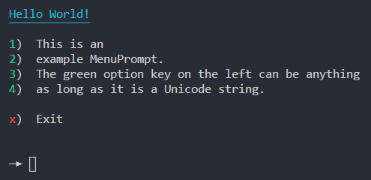
* Example:
* 
*/
class MenuPrompt {
/** This is where all texts of the MenuPrompt are stored. Use this to translate or change them. */
public localization: MenuPromptLocalization;
/**
* 🔹 Creates an interactive prompt with one or many menus - add them using `MenuPrompt.addMenu()`.
* To translate the messages, you can use the `MenuPrompt.localization` object, which is where all localization variables are stored. 🔹
* ❗ Warning: After creating a MenuPrompt object, the process will no longer exit automatically until the MenuPrompt has finished or was explicitly closed. You have to explicitly use process.exit() until the menu has finished or is closed
*
* 
* @param options The options for the prompt
* @constructor
* @since 1.8.0
* @version 1.8.2 Removed second parameter - use `MenuPrompt.addMenu()` instead
* @version 1.9.0 The construction of a MenuPrompt object will now set the process.stdin raw mode to true + There is now a `localization` property you can use to translate some messages
*/
constructor(options?: Partial<MenuPromptOptions>);
/**
* 🔹 Opens the menu 🔹
* ❗ Warning: While the menu is opened you shouldn't write anything to the console / to the stdout and stderr as this could mess up the layout of the menu and/or make stuff unreadable
* @returns Returns true, if the menu could be opened or a string containing an error message, if not
* @since 1.8.0
*/
open(): boolean | string;
/**
* 🔹 Closes the menu prompt and returns the selected options up to this point 🔹
* @returns Returns the results of the menu prompt as an array of objects
* @since 1.8.0
*/
close(): MenuPromptResult[];
/**
* 🔹 Adds a new menu to the menu prompt.
* You can even add new menus while the MenuPrompt is already open. 🔹
* @param menu The menu to add to the menu prompt
* @returns Returns true, if the menu could be added or a string containing an error message, if not
* @since 1.8.0
*/
addMenu(menu: MenuPromptMenu): boolean | string;
/**
* 🔹 Returns the (zero-based) index of the current menu of the menu prompt 🔹
* @returns The zero-based index of the current menu or `-1` if the menu hasn't been opened yet
* @since 1.8.0
*/
currentMenu(): number;
/**
* 🔹 Returns the current results of the menu prompt.
* This does **not** close the menu prompt, unlike `close()` 🔹
* @returns Returns the results of the menu prompt or null, if there aren't any results yet
* @since 1.8.0
*/
result(): MenuPromptResult[] | null;
/**
* 🔹 Checks a menu for valid syntax 🔹
* @param menu The menu that should be validated
* @returns Returns true if the menu is valid, a string array containing the error messages if not
* @throws Throws an error if a falsy parameter or no parameter at all was passed
*/
validateMenu(menu: MenuPromptMenu): boolean | string[];
}
//#SECTION FolderDaemon
/** The options of the FolderDaemon */
interface FolderDaemonOptions
{
[key: string]: string[] | undefined | boolean | number;
/**
* An array of [glob patterns.](https://en.wikipedia.org/wiki/Glob_(programming)) Only the matched files will be supervised by the FolderDaemon.
* Example: `['*.js']` will make the daemon only scan files that end in `.js`.
* ❗ You can only use *either* a whitelist *or* a blacklist, not both!
*/
whitelist?: string[] | undefined;
/*