server-timings
Version:
Adds `Server-Timings` header
54 lines (36 loc) • 1.57 kB
Markdown
# Server Timings
This is a very early release of `server-timings` module, intended as an Express middleware.
## Usage
Firstly you need to load the middleware as early as possible to record the request timing:
```js
const express = require('express');
const app = express();
const timings = require('server-timings');
app.use(timings);
app.use(require('./routes'));
```
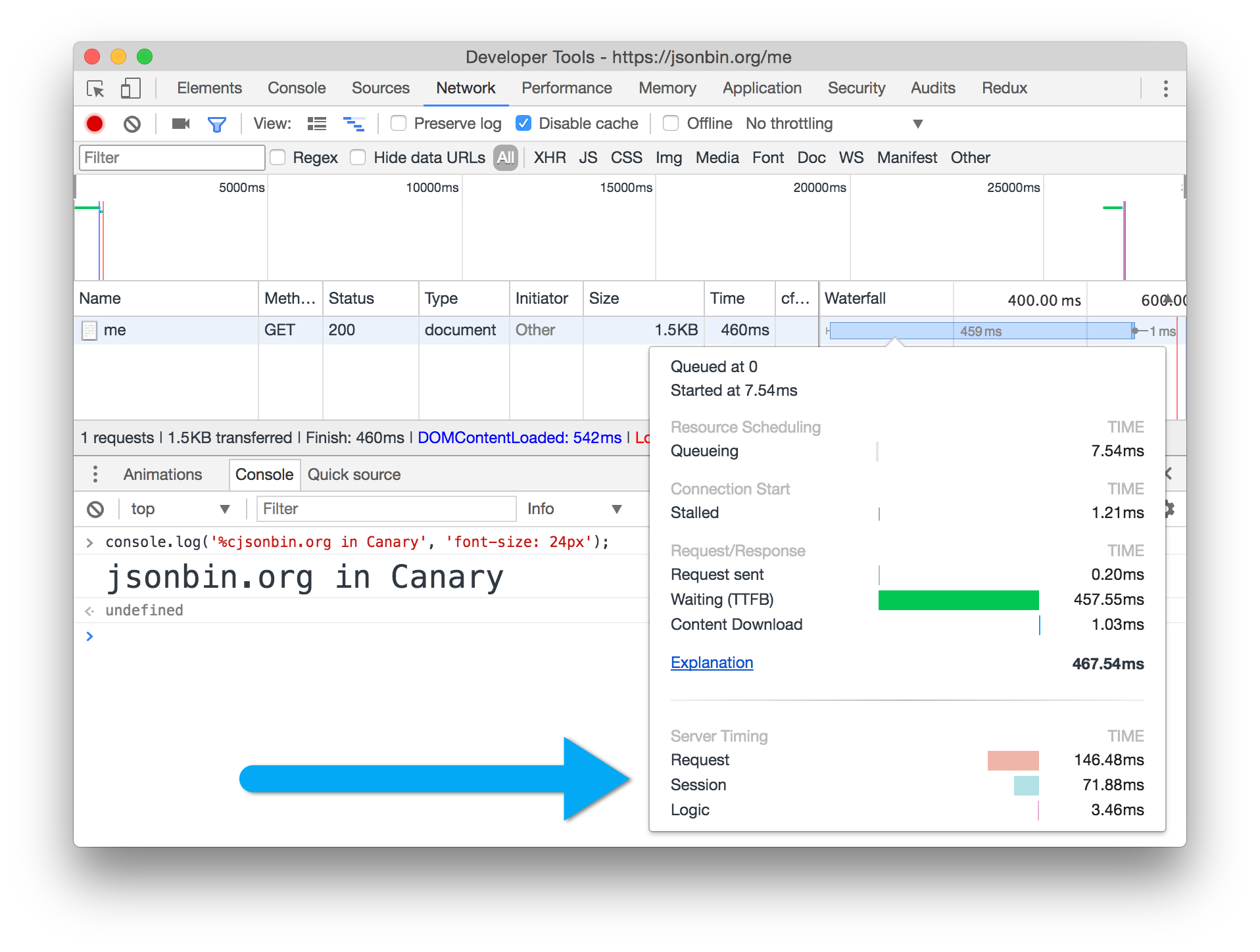
This will automatically add a `Server-Timing` header shown in milliseconds (note that in stable Chrome shows timings in seconds, this will change):
```bash
$ curl https://jsonbin.org/remy/urls -I
HTTP/1.1 200 OK
Content-Type: application/json; charset=utf-8
Server-Timing: 0=72.45; "Request"
```
To include additional timings the middleware exposes two methods on the `res.locals.timings` property:
- `start(label)` - record the start time
- `end(label)` - end the record time - if this isn't called, it will be called when the request is finished
### Start/end as middleware
As well as being exposed in `res.locals.timings` you can also call start and end as middleware:
```js
app.use(timings);
app.use(timings.start('routing'));
app.use(require('./routes'));
app.use(timings.end('routing'));
```
## Live example
See [jsonbin.org](https://jsonbin.org) for a working example. As of March 2017, the networking timings can be seen in Canary:
## Limitations
- Currently only ES6 support (not tranpiled down to ES5…yet)
- Expects `next()` so limited to Express
- Currently no tests(!)