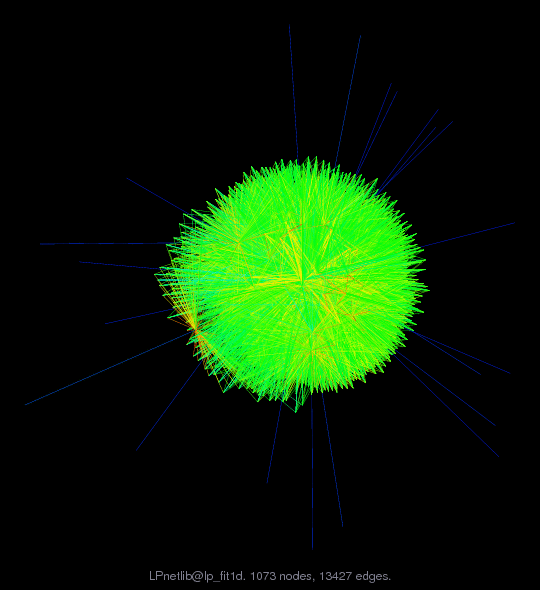
ngraph.sparse-collection
Version:
Subset of the University of Florida sparse matrix collection
120 lines (49 loc) • 4.08 kB
Markdown
UF Sparse Matrix Collection, Tim Davis
http://www.cise.ufl.edu/research/sparse/matrices/LPnetlib/lp_fit1d
[]
id: 624
date: 1990
author: R. Fourer
ed: R. Fourer
fields: title name A b id aux kind date author ed notes
aux: c lo hi z0
kind: linear programming problem
notes:
A Netlib LP problem, in lp/data. For more information
send email to netlib@ornl.gov with the message:
send index from lp
send readme from lp/data
The following are relevant excerpts from lp/data/readme (by David M. Gay):
The column and nonzero counts in the PROBLEM SUMMARY TABLE below exclude
slack and surplus columns and the right-hand side vector, but include
the cost row. We have omitted other free rows and all but the first
right-hand side vector, as noted below. The byte count is for the
MPS compressed file; it includes a newline character at the end of each
line. These files start with a blank initial line intended to prevent
mail programs from discarding any of the data. The BR column indicates
whether a problem has bounds or ranges: B stands for "has bounds", R
for "has ranges". The BOUND-TYPE TABLE below shows the bound types
present in those problems that have bounds.
The optimal value is from MINOS version 5.3 (of Sept. 1988)
running on a VAX with default options.
PROBLEM SUMMARY TABLE
Name Rows Cols Nonzeros Bytes BR Optimal Value
FIT1D 25 1026 14430 51734 B -9.1463780924E+03
BOUND-TYPE TABLE
FIT1D UP
Supplied by Bob Fourer.
When included in Netlib: Cost coefficients negated.
Concerning FIT1D, FIT1P, FIT2D, FIT2P, Bob Fourer says
The pairs FIT1P/FIT1D and FIT2P/FIT2D are primal and
dual versions of the same two problems [except that we
have negated the cost coefficients of the dual problems
so all are minimization problems]. They originate from
a model for fitting linear inequalities to data, by
minimization of a sum of piecewise-linear penalties.
The FIT1 problems are based on 627 data points and 2-3
pieces per primal pl penalty term. The FIT2 problems
are based on 3000 data points (from a different sample
altogether) and 4-5 pieces per pl term.
Added to Netlib on 31 Jan. 1990