missionlog
Version:
🚀 lightweight TypeScript abstract logger • level based filtering and optional tagging • supports both ESM & CJS
234 lines (163 loc) • 8.05 kB
Markdown
# missionlog
[![NPM version][npm-image]][npm-url] [](https://coveralls.io/github/rmartone/missionlog?branch=master) 
[npm-image]: https://img.shields.io/npm/v/missionlog.svg?style=flat
[npm-url]: https://www.npmjs.com/package/missionlog
🚀 **missionlog** is a **lightweight, high-performance structured logging package** designed for **performance, flexibility, and ease of use**. It works as a **drop-in replacement for `console.log` or `ts-log`**, and offers both **log level** filtering, optional **tag** filtering, and **customizable output handling**—all in a tiny (~1KB) package.
✔ **Fully Typed (TypeScript)** • ✔ **ESM & CJS Support** • ✔ **Zero Dependencies** • ✔ **100% Coverage** • ✔ **Optimized Performance**
## ✨ Why Use `missionlog`?
- **Drop-in Replacement for `console.log` & `ts-log`** – Start using it instantly!
- **Seamless Upgrade to Tagged Logging** – Reduce log clutter and focus on what's important.
- **Configurable Log Levels** – Adjust visibility for log level and tags at runtime.
- **Customizable Output** – Send logs anywhere: console, JSON, cloud services.
- **Ultra-Fast Performance** – Optimized with advanced caching and minimal memory allocation.
- **TypeScript-First** – Full type safety with comprehensive JSDoc documentation.
- **Chainable API** – All methods return the logger instance for method chaining.
- **Works Everywhere** – Browser, Node.js, Firebase, AWS Lambda etc.
## ⚡ Performance & Efficiency
**missionlog v4** has been optimized for high-performance applications:
- **Smart Caching** – Level checks are cached to avoid repeated calculations
- **Minimal Memory Allocation** – Reduced garbage collection with optimized array handling
- **Zero String Concatenation** – Efficient cache keys using nested Map structures
- **Type-Safe Tag Access** – Runtime validation with compile-time safety via proxy
- **Optimized Parameter Handling** – Minimal array operations for better performance
Perfect for high-frequency logging scenarios like real-time applications, games, and data processing pipelines.
## 📦 Installing
```sh
npm i missionlog
```
## 🚀 Getting Started
### Basic Usage
Missionlog works as a drop-in replacement for console.log:
```typescript
import { log } from 'missionlog';
// Works just like console.log
log.info('Hello, world!');
log.warn('Warning message');
log.error('Error occurred!');
// Chainable API for fluent logging
log.debug('Starting process').info('Process step 1 complete').warn('Process running slowly');
```
## 💡 Usage Examples
### Using Tags for Categorization
```typescript
import { log, tag, LogLevel, DEFAULT_TAG } from 'missionlog';
// Configure logging levels for different tags
log.init({
network: LogLevel.DEBUG,
ui: LogLevel.INFO,
[DEFAULT_TAG]: LogLevel.WARN, // Default level for uncategorized logs
});
// Log with type-safe tags - autocomplete shows available tags!
log.debug(tag.network, 'Connection established');
log.info(tag.ui, 'Component rendered');
// Typos in tags return undefined, preventing silent errors
log.debug(tag.netwrok, 'This will be logged without tag due to typo');
// Untagged logs use the DEFAULT_TAG level
log.debug("This won't be logged because DEFAULT_TAG is WARN");
log.error('This will be logged because ERROR > WARN');
```
### Custom Log Handler (with Chalk)
```typescript
import { log, LogLevel, LogLevelStr } from 'missionlog';
import chalk from 'chalk';
// Create a custom log handler
function createCustomHandler() {
const logConfig: Record<LogLevelStr, { color: (text: string) => string; method: (...args: unknown[]) => void }> = {
ERROR: { color: chalk.red, method: console.error },
WARN: { color: chalk.yellow, method: console.warn },
INFO: { color: chalk.blue, method: console.log },
DEBUG: { color: chalk.magenta, method: console.log },
TRACE: { color: chalk.cyan, method: console.log },
OFF: { color: () => '', method: () => {} },
};
return (level: LogLevelStr, tag: string, message: unknown, params: unknown[]) => {
const { method, color } = logConfig[level];
const logLine = `[${color(level)}] ${tag ? tag + ' - ' : ''}${message}`;
method(logLine, ...params);
};
}
// Initialize with custom handler
log.init({ network: LogLevel.INFO, [DEFAULT_TAG]: LogLevel.INFO }, createCustomHandler());
// Check if specific levels are enabled before performing expensive operations
if (log.isDebugEnabled('network')) {
// Only perform this expensive operation if DEBUG logs for 'network' will be shown
const stats = getNetworkStatistics(); // Example of an expensive operation
log.debug(tag.network, 'Network statistics', stats);
}
// Similarly for TRACE level
if (log.isTraceEnabled('ui')) {
// Avoid expensive calculations when trace logging is disabled
const detailedMetrics = calculateDetailedRenderMetrics();
log.trace(tag.ui, 'UI rendering detailed metrics', detailedMetrics);
}
// The general method is still available for other log levels
if (log.isLevelEnabled(LogLevel.WARN, 'security')) {
const securityCheck = performSecurityAudit();
log.warn(tag.security, 'Security audit results', securityCheck);
}
```
## ⚠️ Breaking Changes in v4.0.0
### Removed Enhanced Callback
The enhanced callback functionality has been removed to simplify the API:
- ❌ `log.setEnhancedCallback()` method removed
- ❌ `LogCallbackParams` interface removed
- ❌ `EnhancedLogCallback` type removed
**Migration:** Use the standard callback in `log.init()` instead:
```typescript
// ❌ Old way (v3.x)
log.setEnhancedCallback((params) => {
const { level, tag, message, timestamp, params: extraParams } = params;
console.log(`[${timestamp.toISOString()}] [${level}] ${message}`, ...extraParams);
});
// ✅ New way (v4.x)
log.init({}, (level, tag, message, params) => {
const timestamp = new Date().toISOString();
console.log(`[${timestamp}] [${level}] ${message}`, ...params);
});
```
## 📖 API Reference
### Log Methods
All logging methods support both tagged and untagged logging with full type safety:
- `log.trace(messageOrTag?, ...params)` - Lowest verbosity level
- `log.debug(messageOrTag?, ...params)` - Detailed debugging information
- `log.info(messageOrTag?, ...params)` - Notable but expected events
- `log.log(messageOrTag?, ...params)` - Alias for info()
- `log.warn(messageOrTag?, ...params)` - Potential issues or warnings
- `log.error(messageOrTag?, ...params)` - Error conditions
### Configuration & Utilities
- `log.init(config?, callback?)` - Configure log levels and custom handler
- `log.isLevelEnabled(level, tag?)` - Check if a specific level would be logged for a tag
- `log.isDebugEnabled(tag?)` - Convenience method to check if DEBUG level is enabled
- `log.isTraceEnabled(tag?)` - Convenience method to check if TRACE level is enabled
- `log.reset()` - Reset logger to initial state and clear all configurations
### Type-Safe Tag Access
- `tag.{tagName}` - Access registered tags with runtime validation
- Returns the tag name if registered, `undefined` otherwise
- Provides IDE autocomplete for registered tags
### Log Levels (in order of verbosity)
1. `LogLevel.TRACE` - Most verbose
2. `LogLevel.DEBUG`
3. `LogLevel.INFO` - Default level
4. `LogLevel.WARN`
5. `LogLevel.ERROR`
6. `LogLevel.OFF` - No logs
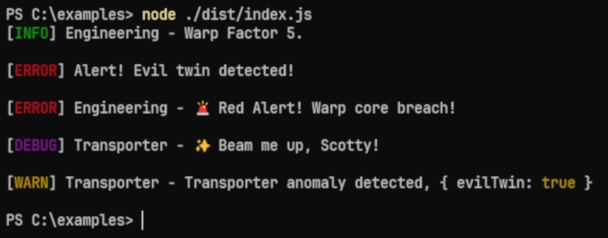
## 🖼️ Example Output
## 🤝 Contributing
Contributions, issues, and feature requests are welcome! Feel free to check [issues page](https://github.com/rmartone/missionlog/issues) or submit a pull request.
## 📄 License
**MIT License**
**© 2019-2025 Ray Martone**
🚀 **Install `missionlog` today and make logging clean, structured, and powerful!**