forerunnerdb
Version:
A NoSQL document store database for browsers and Node.js.
97 lines (76 loc) • 2.83 kB
Markdown
# Astrobench
[](http://badge.fury.io/js/astrobench)
[](http://badge.fury.io/bo/astrobench)
> Make the Web Faster
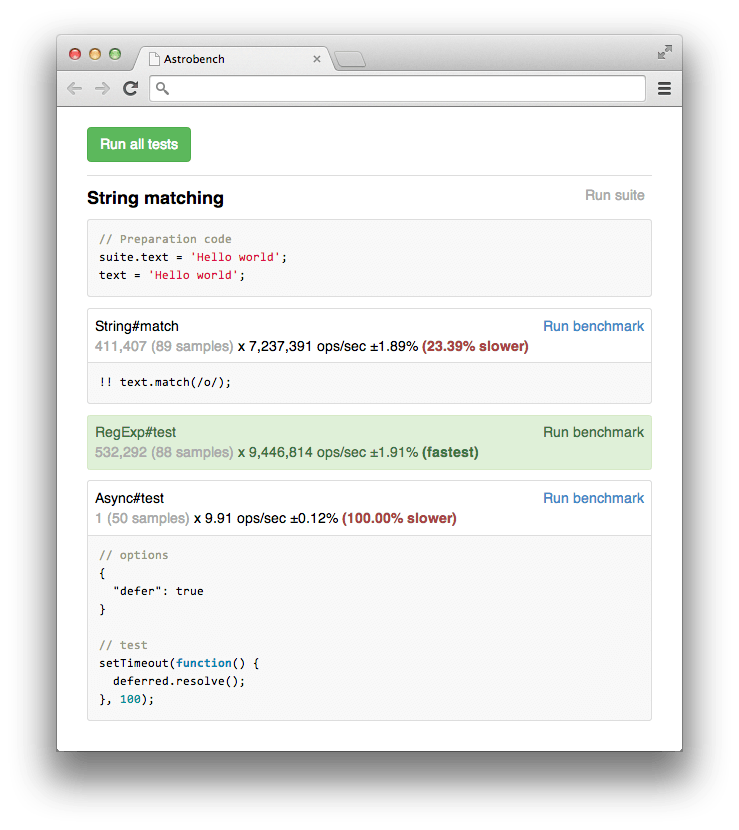
JavaScript library for running in the browser performance benchmarks, based on Benchmark.js. [Live Demo](https://kupriyanenko.github.io/astrobench/demo.html)
Easy way to create test cases. Provides rich and pretty UI.

## Installation
Install with [bower](http://bower.io/)
```
$ bower install astrobench --save
```
Or with [npm](https://www.npmjs.org/)
```
$ npm install astrobench --save
```
## Use it
```html
$ bower install astrobench --save
$ $EDITOR tests.html
<html lang="en">
<head>
<meta charset="UTF-8">
<title>Performance tests</title>
<link rel="stylesheet" href="bower_components/astrobench/src/style.css">
</head>
<body>
<!-- Wrapper for tests -->
<div id="astrobench"></div>
<script src="bower_components/astrobench/dist/astrobench.js"></script>
<script>
// A test suite begins with a call to the global function `suite` with two parameters:
// a string and a function.
// The string is a name or title for a spec suite – usually what is being tested.
// The function is a block of code that implements the suite.
suite('String matching', function(suite) {
var text;
// To help a test suite DRY up any duplicated setup code, provides
// the global `setup` functions.
// As the name implies the `setup` function is called once.
// You can store data in `suite` Object, or define necessary variables.
// Code from body of the function will be presented in UI.
setup(function() {
suite.text = 'Hello world';
text = 'Hello world';
});
// Benchmark are defined by calling the global function `bench`,
// which, like `suite` takes a string and a function.
// The string is the title of the test and the function is the test
bench('String#match', function() {
!! text.match(/o/);
});
bench('RegExp#test', function() {
!! /o/.test(suite.text);
});
// Async benchmark.
// Calls to `bench` can take an optional single argument, Deferred object,
// method .resolve() should be called when the async work is complete.
bench('Async#test', function(deferred) {
setTimeout(function() {
deferred.resolve();
}, 100);
},
// Options for current benchmark
// See more on http://benchmarkjs.com/docs#options
{
defer: true
});
});
</script>
</body>
</html>
```
And enjoy the result.