console-gui-tools
Version:
A simple library to draw option menu, text popup or other widgets and layout on a Node.js console.
183 lines • 6.36 kB
TypeScript
/// <reference types="node" />
/// <reference types="node" />
/// <reference types="node" />
import { EventEmitter } from "events";
/**
* @typedef {Object} MouseEventArgs
* @description This type is used to define the parameters of the Mouse Listener event (mouseevent) data.
*
* @prop {string} code - The code of the pressed key.
* @prop {boolean} alt - If the alt key is pressed.
* @prop {boolean} ctrl - If the ctrl key is pressed.
* @prop {boolean} shift - If the shift key is pressed.
* @prop {boolean} left - If the left mouse key is pressed.
* @prop {boolean} right - If the right mouse key is pressed.
* @prop {number} x - The x position of the mouse (terminal column).
* @prop {number} y - The y position of the mouse (terminal row).
* @prop {number | null} xFrom - The original x position of the mouse (terminal column) when the drag started.
* @prop {number | null} yFrom - The original y position of the mouse (terminal row) when the drag started.
*
* @example const mouseEventArgs = { code: "MOUSE", alt: false, ctrl: false, shift: false, left: true, right: false, x: 10, y: 10, xFrom: null, yFrom: null }
*
* @export
* @interface MouseEventArgs
*/
export interface MouseEventArgs {
code: number;
alt: boolean;
ctrl: boolean;
shift: boolean;
left: boolean;
right: boolean;
x: number;
y: number;
xFrom: number | null;
yFrom: number | null;
}
/**
* @typedef {Object} MouseEvent
* @description This type is used to define the parameters of the Mouse Listener event (mouseevent).
* available event names:
* - MOUSE_MOTION: mouse moved (no button pressed / hover)
* - MOUSE_DRAG: Valorized xFrom and yFrom. Use left or right to know which button is pressed.
* - MOUSE_LEFT_BUTTON_PRESS
* - MOUSE_LEFT_BUTTON_RELEASE
* - MOUSE_RIGHT_BUTTON_PRESS
* - MOUSE_RIGHT_BUTTON_RELEASE
* - MOUSE_MIDDLE_BUTTON_PRESS
* - MOUSE_MIDDLE_BUTTON_RELEASE
* - MOUSE_WHEEL_UP
* - MOUSE_WHEEL_DOWN
*
* @prop {string} name - The name of the event.
* @prop {number} eaten - The number of eaten events.
* @prop {MouseEventArgs} args - The arguments of the event.
*
* @example const mouseEvent = { name: "MOUSE_MOTION", eaten: 0, args: { code: "MOUSE", alt: false, ctrl: false, shift: false, left: true, right: false, x: 10, y: 10, xFrom: null, yFrom: null } }
*
* @export
* @interface MouseEvent
*/
export interface MouseEvent {
name: string;
eaten: number;
data: MouseEventArgs;
}
/**
* @typedef {Object} RelativeMouseEvent
* @description This type is used to define the parameters of the Mouse Listener event (mouseevent) data, relative to a widget.
*
* @prop {string} name - The name of the event.
* @prop {object} data - The data of the event.
* @prop {number} data.x - The x position of the mouse (terminal column).
* @prop {number} data.y - The y position of the mouse (terminal row).
*
* @export
* @interface RelativeMouseEvent
*/
export interface RelativeMouseEvent {
name: string;
data: {
x: number;
y: number;
};
}
/**
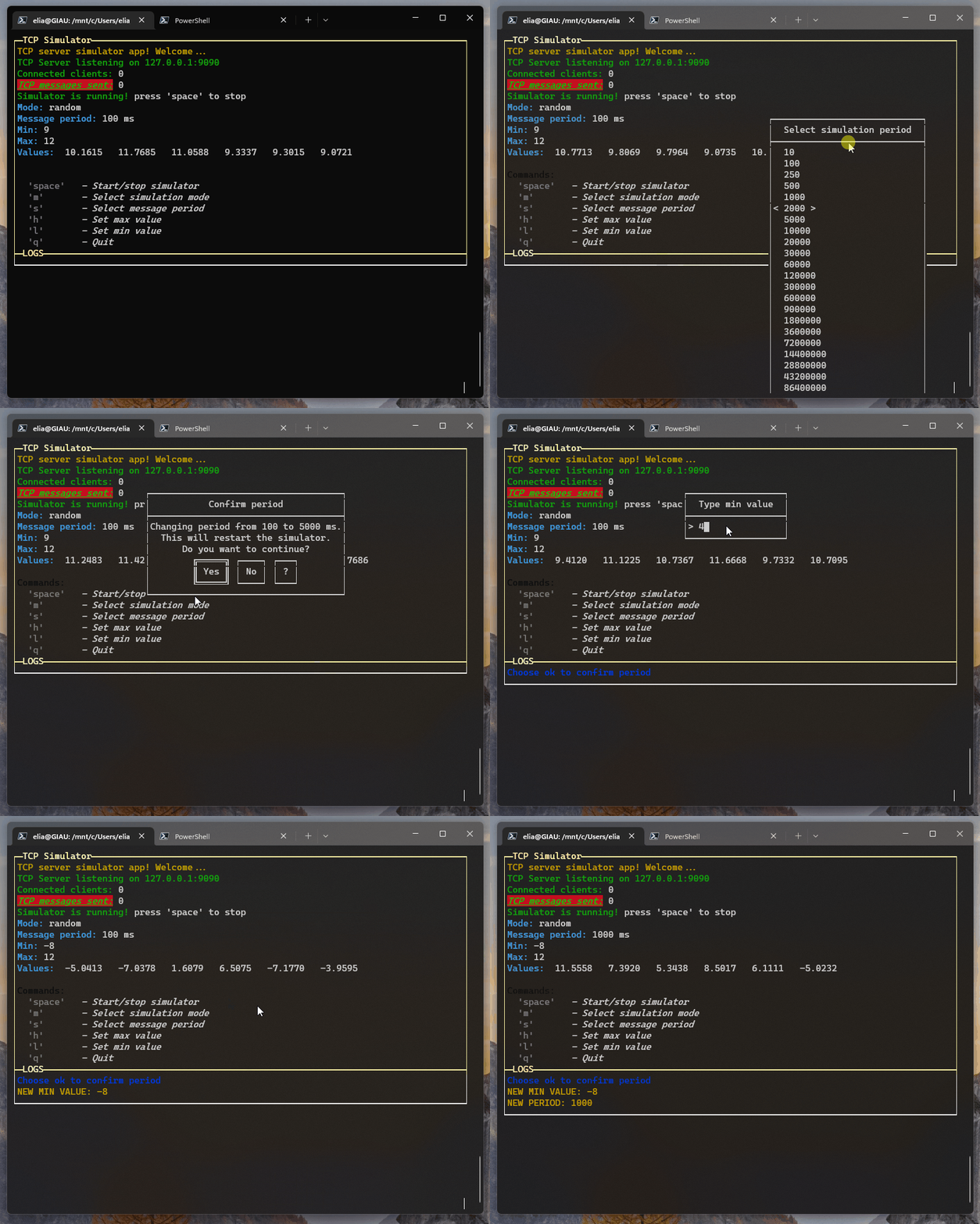
* @class MouseManager
* @description This class is used to manage the mouse tracking events.
*
* 
*
* Emits the following events:
* - "mouseevent" when the user confirm
* - "error" when an error occurs
* @param {object} Terminal - The terminal object (process.stdout).
* @emits mouseevent - The mouse event.
*
* @extends EventEmitter
* @example const mouse = new MouseManager(process.stdout)
*/
export declare class MouseManager extends EventEmitter {
Terminal: NodeJS.WriteStream;
Input: NodeJS.ReadStream;
prependStdinChunk: null | Buffer;
/** @const {Object} keymap - Object containing "MOUSE" array of key codes. */
keymap: {
MOUSE: {
code: string;
event: string;
handler: string;
}[];
};
/** @const {Object} state - Object containing the state of the mouse buttons. */
state: {
button: {
left: {
x: number;
y: number;
} | null;
middle: {
x: number;
y: number;
} | null;
right: {
x: number;
y: number;
} | null;
other: {
x: number;
y: number;
} | null;
};
};
constructor(_Terminal: NodeJS.WriteStream, _Input: NodeJS.ReadStream);
/**
* @description Manage the mouse events for the x11 protocol.
* @param {string} basename - The name of the event.
* @param {Buffer} buffer - The data of the event.
**/
mouseX11Protocol: (basename: string, buffer: Buffer) => MouseEvent;
/**
* @description Manage the mouse events for the SGR protocol.
* @param {string} basename - The name of the event.
* @param {Buffer} buffer - The data of the event.
**/
mouseSGRProtocol: (basename: string, buffer: Buffer) => MouseEvent | {
name: string;
eaten: number;
data: {
matches: RegExpMatchArray | null;
};
};
/**
* @description Enables "mouseevent" event on the *input* stream. Note that `stream` must be
* an *output* stream (i.e. a Writable Stream instance), usually `process.stdout`.
*
* @api public
*/
enableMouse(): void;
/**
* @description Disables "mouseevent" event from being sent to the *input* stream.
* Note that `stream` must be an *output* stream (i.e. a Writable Stream instance),
* usually `process.stdout`.
*
* @api public
*/
disableMouse(): void;
/**
* @description Manage the stdin data to detect mouse events.
* @param {Buffer} chunk - The data of the event.
**/
onStdin: (chunk: Buffer) => void;
/**
* @description Test if the key is a part of the mouse event.
* @param {{ code: string, sequence: string }} key - The key object to test.
* @return {number} - 1 if the key is the header of a mouse event, -1 if is a body part, 0 otherwise.
**/
isMouseFrame(key: {
code: string;
sequence: string;
}, lock: boolean): number;
}
export default MouseManager;
//# sourceMappingURL=MouseManager.d.ts.map