auth0-sso-login
Version:
A Library to simplify the auth0 sso login process
141 lines (118 loc) • 6.96 kB
Markdown
[](https://travis-ci.org/Cimpress-MCP/auth0-sso-login.js)
[](https://www.npmjs.com/package/auth0-sso-login)
The Auth0 SSO Login provides an easy to use library for single-sign on web pages that are leveraging [Auth0](https://auth0.com/).
Select the following options:
* Main settings:
* Client Type: `Single Page Application`
* Allowed Callback URLs: `http://localhost:PORT,https://*.root.domain`
* Allowed Web Origins: `http://localhost:PORT,https://example.root.domain,https://tst-example.root.domain`
* Allowed Logout URLS: `http://localhost:PORT/#/logout,https://*.root.domain/#/logout`
* Allowed Origins (CORS): `http://localhost:PORT,https://*.root.domain`
* Advanced Settings:
* OAuth: `RS256` and OIDC: `on`
* Grant Types: `Implicit, Authorization Code, Password / Password Realm`
### Install the library.
```bash
npm install auth0-sso-login
```
Use the library.
```javascript
// import library
import Auth from 'auth0-sso-login';
// create an instance of Auth
let config = { /* ... */ };
let auth = new Auth(config);
let defaultConfiguration = {
enabledHostedLogin: true, // if Auth0's SSO fails, use the hosted login screen
forceTokenRefresh: false // force refresh even if there is a valid token available
redirectUri: window.location.href, // specify an override
explicitConnection: null // specify an explicit connection to use for this instance of calling ensureLoggedIn, will override the global configuration value
};
// Logs the user in and returns a promise, when succeeded, the user is logged in
// and a valid JWT was provided (via tokenRefreshed hook).
// Schedules automatic background renewal of JWT based on its expiry time.
// (it will be refresh in the 2/3 of the current token lifetime)
try {
let result = await auth.ensureLoggedIn(defaultConfiguration)
console.log('user is logged in, if a previous redirect was saved direct the user to the redirect location');
// The redirect saved in the configuration passed in will not be correct, as it was generated in "this" session instead of the session which created the correct redirect.
if (result.redirectUri) {
window.location.replace(result.redirectUri);
}
} catch (error) {
console.error('an unexpected error occurred while logging in');
// perform application specific steps to handle this situation
// this should happen only rarely, since the user will either
// be logged in automatically through Auth0's SSO feature, or
// the Universal Hosted Login page, and only succeed after the
// user successfully logged in. In the case of the redirect,
// the redirectUri will be loaded
});
```
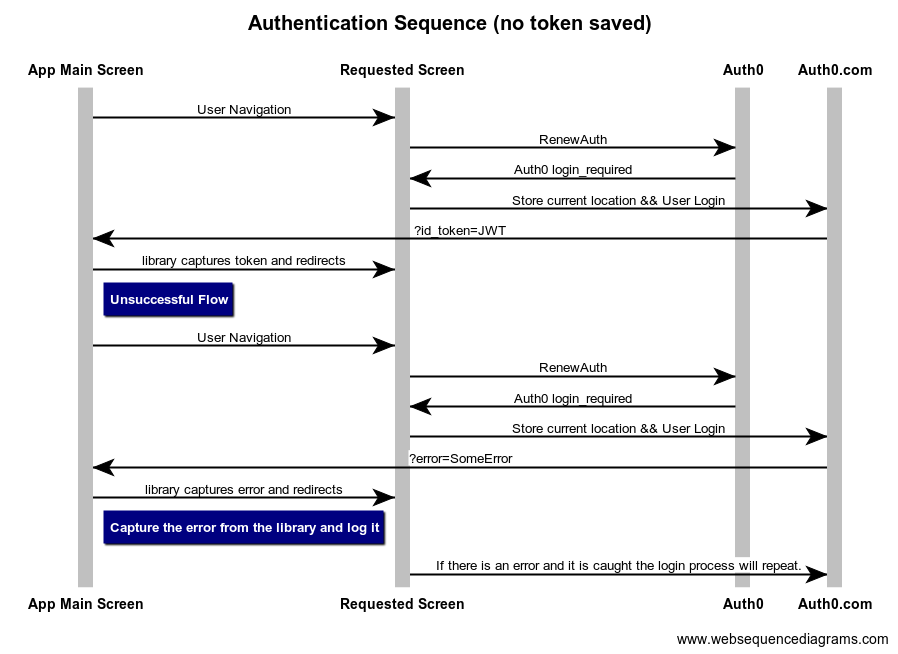
After the login process, the token is retrieved via `tokenRefreshed` hook, described in the
configuration options bellow. The library also exposes its latest idToken result, which may or
may not be set (depends on the success/failure of login process). This method can be used as
a token provider for HTTP clients.
```javascript
let idToken = auth.getIdToken();
```
The profile is exposed as well, as a promise.
```javascript
let profilePromise = auth.getProfile();
```
Several configuration options and hooks are provided to interact with the library.
```javascript
let config = {
// the auth0 client ID to be used - see https://auth0.com/docs/api-auth/tutorials/client-credentials
clientId: 'specify the auth0 client ID',
// the auth0 domain to login - see https://auth0.com/docs/api-auth/tutorials/client-credentials
domain: 'specify the auth0 domain, usually something like <youraccount>.auth0.com',
// the auth0 audience - see https://auth0.com/docs/api-auth/tutorials/client-credentials
audience: 'specify the auth0 audience, as agreed for the set of applications with the same audience',
// the logout URL, which should be accessible by a non-authenticated user, default is `window.location.href`
logoutRedirectUri: `${window.location.origin}/
// the application root, by default the redirect from universal lock will redirect here before replacing history with the specified redirect.
applicationRoot: '/',
// specify an explicit connection to use, which allows bypassing the lock widget
explicitConnection: null,
// hooks to get callback calls into the login/logout workflow
hooks: {
// before the redirect to the redirectUri happens (with fallback to logoutRedirectUri and then to window.location.href)
// if the user information is stored in a backend store, it's best to clean that before the redirect happens
logout(redirectUri) {
// implement what should happen at logout
// a typical use case is to remove the auth token from your storage (memory, cookie, local store), or perform other cleanup tasks
},
// the profile was retrieved, this is an option to store the profile, or update the user interface
profileRefreshed(profile) {
// once the profile is refreshed, which includes the auth0 sub and other meta data
// a typical use case is to show the username on screen
// or use getProfile()
},
// the auth token was retrieved, this is an option to store the token for later use
tokenRefreshed() {
// once a new token was retrieved from auth0, this happens right before expiry. When using getIdToken(), it may be an unnecessary hook.
},
// called before logout or when there's a problem with the current user, for example an invalid token
// this gives implementors the option to remove the current user's details from the store if saved
removeLogin() {
// typical use case it to provide the same method as for logout
},
// allows to override log messages; defaults to log to the console
log(messageObject) {
// some debug message objects from the library; can be overridden to not log to the console
}
}
};
```
We value your input as part of direct feedback to us, by filing issues, or preferably by directly contributing improvements:
1. Fork this repository
1. Create a branch
1. Contribute
1. Pull request