arch-unit-ts
Version:
337 lines (273 loc) • 12.9 kB
Markdown
# arch-unit-ts
arch-unit-ts is a free library for checking your typescript architecture. Inspired by [ArchUnit](https://github.com/TNG/ArchUnit) .
This library can check dependencies between packages and classes, and enforce method-level conventions (decorators, async). The main goal of Arch-Unit-ts is to automatically test architecture and coding rules of your project.
We began to implement functionalities in order to be able to test a hexagonal architecture the same way it is done in [JhipsterLite](https://github.com/jhipster/jhipster-lite/blob/main/src/test/java/tech/jhipster/lite/HexagonalArchTest.java)
<!-- TOC -->
- [How to use](#how-to-use)
- [Installation](#installation)
- [Hexagonal Arch Test example](#hexagonal-arch-test-example)
- [Method-level rules](#method-level-rules)
- [Configuration](#configuration)
- [Troubleshooting](#troubleshooting)
<!-- TOC -->
## How to use
I tried to stay as close as I could to ArchUnit. If something is implemented, it should work the same way as the original one.
### Installation
`npm install arch-unit-ts`
### Hexagonal Arch Test example
First, you will need to create two files SharedKernel.ts and BusinessContext.ts.
You can place them at the root of you webapp project.
```
export abstract class SharedKernel {}
```
```
export abstract class BusinessContext {}
```
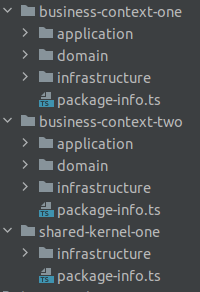
Then, in each context you have, you will need to add a package-info.ts in the context root folder.
If it's a business context, make it extends BusinessContext.
If it's a shared kernel, make it extends SharedKernel.
The important part is the imports, make sure you import only one of them.
```
import { SharedKernel } from "@/SharedKernel";
class PackageInfo extends SharedKernel {}
/// OR
import {BusinessContext} from "@/BusinessContext";
class PackageInfo extends BusinessContext {}
```
Example of packages:
Then, you can create an HexagonalArchTest.spec.ts.
The path of your source project (folder from which you want to test your architecture) is a relative path starting from your tsconfig.json file.
```
import { TypeScriptProject } from 'arch-unit-ts/dist/arch-unit/core/domain/TypeScriptProject';
import { RelativePath } from 'arch-unit-ts/dist/arch-unit/core/domain/RelativePath';
import { classes, noClasses } from 'arch-unit-ts/dist/main';
import { SharedKernel } from '@/app/SharedKernel';
import { BusinessContext } from '@/app/BusinessContext';
import { Architectures } from 'arch-unit-ts/dist/arch-unit/library/Architectures';
describe('HexagonalArchTest', () => {
const srcProject = new TypeScriptProject(RelativePath.of('src/main/app'), '**/*FilesToExclude*', '**/*OtherFilesToExclude*');
const sharedKernels = packagesWithContext(SharedKernel.name);
const businessContexts = packagesWithContext(BusinessContext.name);
function otherBusinessContextsDomains(context: string): string[] {
return businessContexts.filter(other => context !== other).map(name => name + '.domain..');
}
function packagesWithContext(contextName: string): string[] {
return srcProject
.filterClasses('**/package-info.ts')
.filter(typeScriptClass => typeScriptClass.hasImport(contextName))
.map(typeScriptClass => typeScriptClass.packagePath.getDotsPath());
}
describe('BoundedContexts', () => {
it.each([...sharedKernels, ...businessContexts])('Should %s not depend on other bounded context domains', (context) => {
noClasses()
.that()
.resideInAnyPackage(context + '..')
.should()
.dependOnClassesThat()
.resideInAnyPackage(...otherBusinessContextsDomains(context))
.because('Contexts can only depend on classes in the same context or shared kernels')
.check(srcProject.allClasses());
});
it('primary TypeScript Adapters should only be called from secondaries', () => {
classes()
.that()
.resideInAPackage('..primary..')
.and()
.haveSimpleNameStartingWith('TypeScript')
.should()
.onlyHaveDependentClassesThat()
.resideInAPackage('..secondary..')
.because(
"To interact between two contexts, secondary from context 'A' should call a primary TypeScript adapter (naming convention starting with 'TypeScript') from context 'B'"
)
.check(srcProject.allClasses());
});
});
describe('Domain', () => {
it('Should not depend on outside', () => {
classes()
.that()
.resideInAPackage('..domain..')
.should()
.onlyDependOnClassesThat()
.resideInAnyPackage('..domain..', ...sharedKernels)
.because('Domain model should only depend on domains and a very limited set of external dependencies')
.check(srcProject.allClasses());
});
it.each([...sharedKernels, ...businessContexts])('should be an hexagonal architecture in context %s', context => {
Architectures.layeredArchitecture()
.consideringOnlyDependenciesInAnyPackage(context + '..')
.withOptionalLayers(true)
.layer('domain models', context + '.domain..')
.layer('domain services', context + '.domain..')
.layer('application services', context + '.application..')
.layer('primary adapters', context + '.infrastructure.primary..')
.layer('secondary adapters', context + '.infrastructure.secondary..')
.whereLayer('application services')
.mayOnlyBeAccessedByLayers('primary adapters')
.whereLayer('primary adapters')
.mayNotBeAccessedByAnyLayer()
.whereLayer('secondary adapters')
.mayNotBeAccessedByAnyLayer()
.because('Each bounded context should implement an hexagonal architecture')
.check(srcProject.allClasses());
});
});
describe('Application', () => {
it('Should not depend on infrastructure', () => {
noClasses()
.that()
.resideInAPackage('..application..')
.should()
.dependOnClassesThat()
.resideInAnyPackage('..infrastructure..')
.because('Application should only depend on domain, not on infrastructure')
.check(srcProject.allClasses());
});
});
describe('Primary', () => {
it('Should not depend on secondary', () => {
noClasses()
.that()
.resideInAPackage('..primary..')
.should()
.dependOnClassesThat()
.resideInAnyPackage('..secondary..')
.because('Primary should not interact with secondary')
.check(srcProject.allClasses());
});
});
describe('Secondary', () => {
it('should not depend on application', () => {
noClasses()
.that()
.resideInAPackage('..infrastructure.secondary..')
.should()
.dependOnClassesThat()
.resideInAPackage('..application..')
.because('Secondary should not depend on application')
.check(srcProject.allClasses());
});
it.each([...sharedKernels, ...businessContexts])('should %s not depend on same context primary', (context) => {
noClasses()
.that()
.resideInAPackage(context + '.infrastructure.secondary..')
.should()
.onlyDependOnClassesThat()
.resideInAPackage(context + '.infrastructure.primary..')
.because("Secondary should not loop to its own context's primary")
.check(srcProject.allClasses());
});
});
});
```
### Method-level rules
In addition to class-level rules, arch-unit-ts supports architecture rules at the **method level** using `methods()` and `noMethods()`. This is useful for enforcing decorator and async conventions on service methods.
#### Import
```ts
import { ArchRuleDefinition } from 'arch-unit-ts/dist/arch-unit/lang/synthax/ArchRuleDefinition';
```
#### Available predicates in `.that()`
| Predicate | Description |
| ----------------------------- | -------------------------------------------------------------------------------------------------- |
| `.arePublic()` | Matches methods without a private/protected modifier |
| `.areNotAbstract()` | Matches concrete (non-abstract) methods |
| `.areAsync()` | Matches methods declared with the `async` keyword |
| `.areDecoratedWith('Name')` | Matches methods annotated with `@Name(...)` |
| `.areDeclaredInClassesThat()` | Delegates to a class predicate (e.g. `.resideInAnyPackage(...)`, `.haveSimpleNameEndingWith(...)`) |
Predicates can be chained with `.and()` and `.or()`.
#### Available conditions in `.should()`
| Condition | Description |
| ---------------------------- | ------------------------------------------------ |
| `.beDecoratedWith('Name')` | The method must carry the decorator `@Name` |
| `.beAsync()` | The method must be declared `async` |
| `.beDeclaredInClassesThat()` | The declaring class must match a class predicate |
Conditions can be chained with `.andShould()` and `.orShould()`.
#### Example: all public application-service methods must be `@Transactional` or `@NotTransactional`
```ts
import { TypeScriptProject } from 'arch-unit-ts/dist/arch-unit/core/domain/TypeScriptProject';
import { RelativePath } from 'arch-unit-ts/dist/arch-unit/core/domain/RelativePath';
import { ArchRuleDefinition } from 'arch-unit-ts/dist/arch-unit/lang/synthax/ArchRuleDefinition';
describe('TransactionalArchTest', () => {
const project = new TypeScriptProject(RelativePath.of('src/main/app'));
const allClasses = project.allClasses();
it('public methods of application services must be @Transactional or @NotTransactional', () => {
ArchRuleDefinition.methods()
.that()
.arePublic()
.and()
.areNotAbstract()
.and()
.areDeclaredInClassesThat()
.resideInAnyPackage('..application..')
.and()
.areDeclaredInClassesThat()
.haveSimpleNameEndingWith('ApplicationService.ts')
.should()
.beDecoratedWith('Transactional')
.orShould()
.beDecoratedWith('NotTransactional')
.orShould()
.beDeclaredInClassesThat()
.areDecoratedWith('Transactional')
.orShould()
.beDeclaredInClassesThat()
.areDecoratedWith('NotTransactional')
.because('All application service methods must declare their transactional intent')
.allowEmptyShould(true)
.check(allClasses);
});
});
```
#### Example: methods decorated with `@Transactional` must be `async`
```ts
it('methods decorated with @Transactional must be async', () => {
ArchRuleDefinition.methods().that().areDecoratedWith('Transactional').should().beAsync().allowEmptyShould(true).check(allClasses);
});
```
#### Example: async methods in application services must carry `@Transactional`
```ts
it('async application service methods must be @Transactional', () => {
ArchRuleDefinition.methods()
.that()
.areAsync()
.and()
.areDeclaredInClassesThat()
.resideInAnyPackage('..application..')
.should()
.beDecoratedWith('Transactional')
.allowEmptyShould(true)
.check(allClasses);
});
```
#### Using `noMethods()` (inverted rule)
`noMethods()` fails if **any** method matches the condition, instead of failing when one does not:
```ts
it('no application service method should be decorated with @Deprecated', () => {
ArchRuleDefinition.noMethods()
.that()
.areDeclaredInClassesThat()
.haveSimpleNameEndingWith('ApplicationService.ts')
.should()
.beDecoratedWith('Deprecated')
.allowEmptyShould(true)
.check(allClasses);
});
```
#### `allowEmptyShould` and `because`
- `.allowEmptyShould(true)` — silently passes when no method matches the `.that()` clause (useful when a feature is not yet present in all projects).
- `.allowEmptyShould(false)` — throws if no method is checked (default: driven by `arch-unit-ts.json`).
- `.because('reason')` — appends a human-readable explanation to the violation message.
### Configuration
You can add a configuration file at your project root called arch-unit-ts.json with the following properties (default values bellow).
```
{
"showImportsWarning": true,
"failOnEmptyShould": false
}
```
### Troubleshooting
TsMorph might have difficulties to read some dependencies.
When it happens, a warn will be printed in the console.
With jest, this warn might be quite big because its console also print the place where the warn has happened. (Switch to vitest ? :p)