@thi.ng/fuzzy
Version:
Fuzzy logic operators & configurable rule inferencing engine
378 lines (303 loc) • 15.9 kB
Markdown
<!-- This file is generated - DO NOT EDIT! -->
<!-- Please see: https://github.com/thi-ng/umbrella/blob/develop/CONTRIBUTING.md#changes-to-readme-files -->
# 
[](https://www.npmjs.com/package/@thi.ng/fuzzy)

[](https://mastodon.thi.ng/@toxi)
> [!NOTE]
> This is one of 213 standalone projects, maintained as part
> of the [.ng/umbrella](https://github.com/thi-ng/umbrella/) monorepo
> and anti-framework.
>
> 🚀 Please help me to work full-time on these projects by [sponsoring me on
> GitHub](https://github.com/sponsors/postspectacular). Thank you! ❤️
- [About](#about)
- [Features](#features)
- [References / Further reading](#references--further-reading)
- [Status](#status)
- [Support packages](#support-packages)
- [Installation](#installation)
- [Dependencies](#dependencies)
- [API](#api)
- [Fuzzy set generators & combinators](#fuzzy-set-generators--combinators)
- [Linguistic variables](#linguistic-variables)
- [Rule creation & inferencing](#rule-creation--inferencing)
- [Authors](#authors)
- [License](#license)
## About
Fuzzy logic operators & configurable rule inferencing engine.
### Features
- Entirely declarative & functional approach
- Fully type checked
- Fuzzy set domain shaping & composition functions (incl. negated / inverse)
- Various [T-norms &
S-norms](https://github.com/thi-ng/umbrella/blob/develop/packages/fuzzy/src/tnorms.ts),
incl. parametric versions
- Rules with multiple inputs/outputs and arbitrary term combinators (i.e.
T-norms). Syntax sugar for common `and`/`or` rules.
- Defuzzification via customizable strategies and options to balance precision
vs. performance
- Maxima: First, Last, Mean
- Center-of-Gravity (COG)
- Linguistic variable creation and term/set classification for given domain
values
- Fuzzy set visualization (via
[.ng/fuzzy-viz](https://github.com/thi-ng/umbrella/tree/develop/packages/fuzzy-viz))
### References / Further reading
- [Fuzzy Logic (Wikipedia)](https://en.wikipedia.org/wiki/Fuzzy_logic)
- [T-norm (Wikipedia)](https://en.wikipedia.org/wiki/T-Norm)
- [Fuzzy Logic - University of Western Australia](https://teaching.csse.uwa.edu.au/units/CITS7212/Lectures/Students/Fuzzy.pdf)
- [Introduction to Fuzzy Logic](https://www.researchgate.net/publication/267041266_Introduction_to_fuzzy_logic)
- [Defuzzification (Wikipedia)](https://en.wikipedia.org/wiki/Defuzzification)
- [Defuzzification methods](https://cse.iitkgp.ac.in/~dsamanta/courses/archive/sca/Archives/Chapter%205%20Defuzzification%20Methods.pdf)
- [Comparison of the COG Defuzzification Technique](https://arxiv.org/pdf/1612.00742.pdf)
## Status
**STABLE** - used in production
[Search or submit any issues for this package](https://github.com/thi-ng/umbrella/issues?q=%5Bfuzzy%5D+in%3Atitle)
## Support packages
- [.ng/fuzzy-viz](https://github.com/thi-ng/umbrella/tree/develop/packages/fuzzy-viz) - Visualization, instrumentation & introspection utils for [@thi.ng/fuzzy](https://github.com/thi-ng/umbrella/tree/develop/packages/fuzzy)
## Installation
```bash
yarn add .ng/fuzzy
```
ESM import:
```ts
import * as fuzzy from "@thi.ng/fuzzy";
```
Browser ESM import:
```html
<script type="module" src="https://esm.run/@thi.ng/fuzzy"></script>
```
[JSDelivr documentation](https://www.jsdelivr.com/)
For Node.js REPL:
```js
const fuzzy = await import("@thi.ng/fuzzy");
```
Package sizes (brotli'd, pre-treeshake): ESM: 1.62 KB
## Dependencies
- [.ng/api](https://github.com/thi-ng/umbrella/tree/develop/packages/api)
- [.ng/math](https://github.com/thi-ng/umbrella/tree/develop/packages/math)
Note: .ng/api is in _most_ cases a type-only import (not used at runtime)
## API
[Generated API docs](https://docs.thi.ng/umbrella/fuzzy/)
(See
[tests](https://github.com/thi-ng/umbrella/tree/develop/packages/fuzzy/test) for
more usage examples).
### Fuzzy set generators & combinators
Generators:
- `constant()`
- `point()`
- `ramp()` / `invRamp()`
- `triangle()`
- `trapezoid()`
- `sigmoid()` / `invSigmoid()`
- `gaussian()`
Combinators:
- `negate()`
- `weighted()`
- `alphaCut()` / `invAlphaCut()`
- `compose()` / `intersect()` / `union()`
### Linguistic variables
Linguistic variables (short: **L-var**s) are groupings of named (and possibly
overlapping) fuzzy sets within a given value domain. The can be used standalone
or as inputs/outputs in rules (further below).
The
[.ng/fuzzy-viz](https://github.com/thi-ng/umbrella/tree/develop/packages/fuzzy-viz)
package provides utilities to visualize the fuzzy sets of an L-var.

```ts
import {
variable, invSigmoid, sigmoid, trapezoid,
evaluate, classify
} from "@thi.ng/fuzzy";
// temperature sets (in celsius)
const temp = variable(
// value domain
[-20, 40],
{
freezing: invSigmoid(0, 2),
cold: trapezoid(-1, 2, 16, 20),
warm: trapezoid(15, 20, 30, 34),
hot: sigmoid(32, 2)
}
);
// evaluate all fuzzy sets for given domain value
evaluate(temp, 18)
// {
// freezing: 2.220446049250313e-16,
// cold: 0.5,
// warm: 0.6,
// hot: 6.914400106935423e-13
// }
evaluate(temp, 28)
// {
// freezing: 0,
// cold: 0,
// warm: 1,
// hot: 0.0003353501304664781
// }
// classify temperature (min confidence 33%, default: 50%)
classify(temp, 28, 0.33)
// "warm"
```
### Rule creation & inferencing
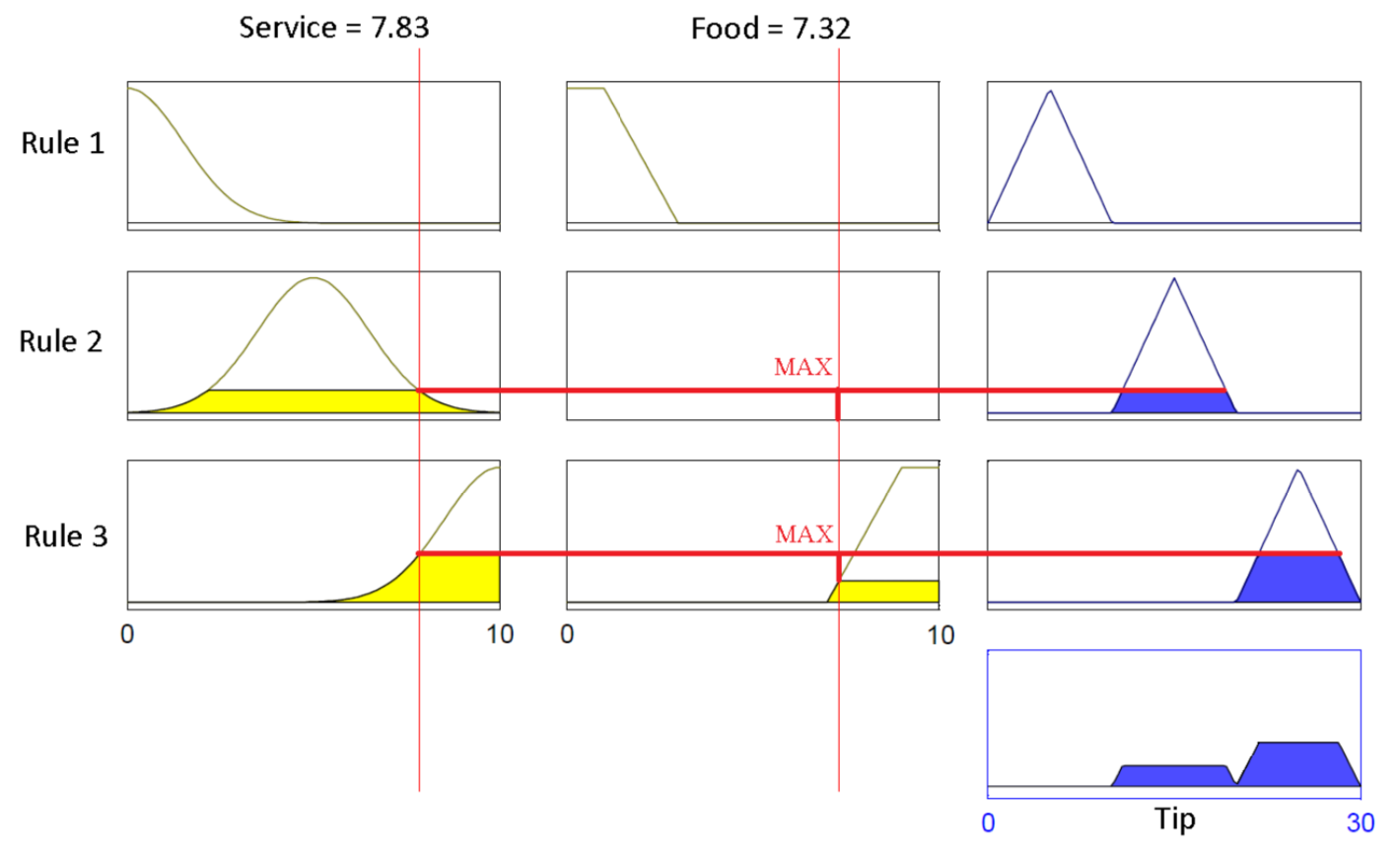
Example taken from Franck Dernoncourt's [Introduction to Fuzzy
Logic](https://www.researchgate.net/publication/267041266_Introduction_to_fuzzy_logic):
```ts
import {
variable, ramp, invRamp, gaussian, triangle,
or, defuzz, meanOfMaximaStrategy
} from "@thi.ng/fuzzy";
// define fuzzy input variables
const inputs = {
food: variable([0, 10], {
awful: invRamp(1, 3),
delicious: ramp(7, 9),
}),
service: variable([0, 10], {
poor: gaussian(0, 1.5),
good: gaussian(5, 1.5),
excellent: gaussian(10, 1.5),
}),
};
const outputs = {
tip: variable([0, 30], {
low: triangle(0, 5, 10),
medium: triangle(10, 15, 20),
high: triangle(20, 25, 30),
}),
};
// l-vars, rules and defuzzification are using generics for type safety
// we define these 2 type aliases for brevity
type I = typeof inputs;
type O = typeof outputs;
// rule definitions:
// if service is poor OR food is awful -> tip is low
// if service is normal -> tip is medium
// if service is excellent OR food is delicious -> tip is high
const rules = [
or<I, O>({ food: "awful", service: "poor" }, { tip: "low" }),
or<I, O>({ service: "good" }, { tip: "medium" }),
or<I, O>({ food: "delicious", service: "excellent" }, { tip: "high" }),
];
// defuzzification using default center-of-gravity strategy
defuzz(
inputs,
outputs,
rules,
// input values
{ food: 7.32, service: 7.83 },
);
// { tip: 22.650000000000034 }
// defuzz with custom strategy (note: each has further config options)
defuzz(
inputs,
outputs,
rules,
// input values
{ food: 7.32, service: 7.83 },
// custom defuzz strategy
meanOfMaximaStrategy()
);
// { tip: 25.050000000000043 }
```
Note: The results are slightly different than those in the textbook example, due
to different `gaussian` fuzzy sets used for the `service` L-var.
Using `instrumentStrategy()` from the upcoming
[.ng/fuzzy-viz](https://github.com/thi-ng/umbrella/tree/develop/packages/fuzzy-viz)
package, we can also visualize the final, transformed fuzzy sets used to compute
crisp results and highlight the position of the crisp result value.
Here is the ASCII art output for the
[`centroidStrategy`](https://docs.thi.ng/umbrella/fuzzy/functions/centroidStrategy.html)
and using `tnormMin` (the default) to transform each rule's output set(s):
```ts
import { defuzz, centroidStrategy } from "@thi.ng/fuzzy";
import { instrumentStrategy, fuzzySetToAscii } from "@thi.ng/fuzzy-viz";
// wrap existing strategy
const strat = instrumentStrategy(centroidStrategy(), fuzzySetToAscii());
// call defuzz as normal
defuzz(inputs, outputs, rules, strat);
// obtain secondary results via deref()
console.log(strat.deref()[0]);
```
```text
........................................................................|...........................
........................................................................|...........................
........................................................................|...........................
........................................................................|...........................
........................................................................|...........................
........................................................................|...........................
........................................................................|...........................
........................................................................|...........................
........................................................................|...........................
........................................................................|...........................
........................................................................|▅▅▅▅▅▅▅▅▅▅▅▅▅▅▅▅▅▅▅▅▅▅.....
.......................................................................▁|██████████████████████▇....
......................................................................▁█|███████████████████████▇...
....................................▅▆▆▆▆▆▆▆▆▆▆▆▆▆▆▆▆▆▆▆▆▆▆▆▆▆▆▆▅....▂██|████████████████████████▇..
...................................▅█████████████████████████████▅..▂███|██████████████████████████.
..................................▅███████████████████████████████▅▂████|███████████████████████████
^ 21.52
```
Different results can be obtained by adjusting the
[T-norm](https://en.wikipedia.org/wiki/T-Norm) used to transform each rule's
output sets, here using `tnormHamacher(2)`.
```text
.........................................................................|..........................
.........................................................................|..........................
.........................................................................|..........................
.........................................................................|..........................
.........................................................................|..........................
.........................................................................|..........................
.........................................................................|..........................
.........................................................................|..........................
.........................................................................|..........................
.........................................................................|..........................
.........................................................................|.........▃▂...............
.........................................................................|.......▃███▆▂.............
.........................................................................|....▁▅███████▇▃...........
................................................▁▃▆▃▁....................|.▁▄▇████████████▆▃........
...........................................▁▂▄▆███████▆▄▂▁..............▂|▇██████████████████▆▃▁....
...................................▁▂▃▄▅▆▇█████████████████▇▆▅▄▃▂▁..▂▄▆██|███████████████████████▅▃▁
^ 21.84
```
...or using `tnormAczelAlsina(2)` (there're many more available):
```text
........................................................................|...........................
........................................................................|...........................
........................................................................|...........................
........................................................................|...........................
........................................................................|...........................
........................................................................|...........................
........................................................................|...........................
........................................................................|...........................
........................................................................|...........................
........................................................................|...........................
........................................................................|.....▂▃▄▅▅▅▅▅▄▄▃▁..........
........................................................................|.▂▅▇██████████████▆▄.......
........................................................................|▇████████████████████▆▂....
........................................▁▂▃▄▄▅▅▆▆▆▆▆▆▆▅▅▄▄▃▂▁.........▃█|███████████████████████▆▁..
....................................▂▄▇███████████████████████▇▄▂....▆██|█████████████████████████▄.
..................................▃▇█████████████████████████████▇▃▂████|██████████████████████████▇
^ 21.58
```
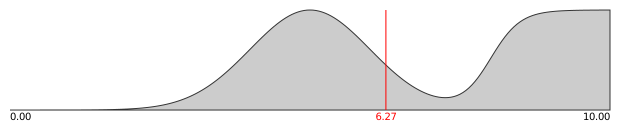
Just for illustration purposes (and using a different example), SVG output can
be obtained by merely switching to another instrumentation function (here
`fuzzySetToSvg()`):
## Authors
- [Karsten Schmidt](https://thi.ng)
If this project contributes to an academic publication, please cite it as:
```bibtex
{thing-fuzzy,
title = "@thi.ng/fuzzy",
author = "Karsten Schmidt",
note = "https://thi.ng/fuzzy",
year = 2020
}
```
## License
© 2020 - 2026 Karsten Schmidt // Apache License 2.0