@thi.ng/cellular
Version:
Highly customizable 1D cellular automata, shared env, multiple rules, arbitrary sized/shaped neighborhoods, short term memory, cell states etc.
322 lines (244 loc) • 11.6 kB
Markdown
<!-- This file is generated - DO NOT EDIT! -->
<!-- Please see: https://github.com/thi-ng/umbrella/blob/develop/CONTRIBUTING.md#changes-to-readme-files -->
# 
[](https://www.npmjs.com/package/@thi.ng/cellular)

[](https://mastodon.thi.ng/@toxi)
> [!NOTE]
> This is one of 209 standalone projects, maintained as part
> of the [.ng/umbrella](https://github.com/thi-ng/umbrella/) monorepo
> and anti-framework.
>
> 🚀 Please help me to work full-time on these projects by [sponsoring me on
> GitHub](https://github.com/sponsors/postspectacular). Thank you! ❤️
- [About](#about)
- [Neighborhoods](#neighborhoods)
- [Rule encoding](#rule-encoding)
- [Cell states](#cell-states)
- [Wraparound](#wraparound)
- [Masks](#masks)
- [Limits](#limits)
- [Status](#status)
- [Related packages](#related-packages)
- [Installation](#installation)
- [Dependencies](#dependencies)
- [API](#api)
- [Code examples](#code-examples)
- [Classic Wolfram](#classic-wolfram)
- [Custom kernels & multiple rules](#custom-kernels--multiple-rules)
- [Authors](#authors)
- [License](#license)
## About
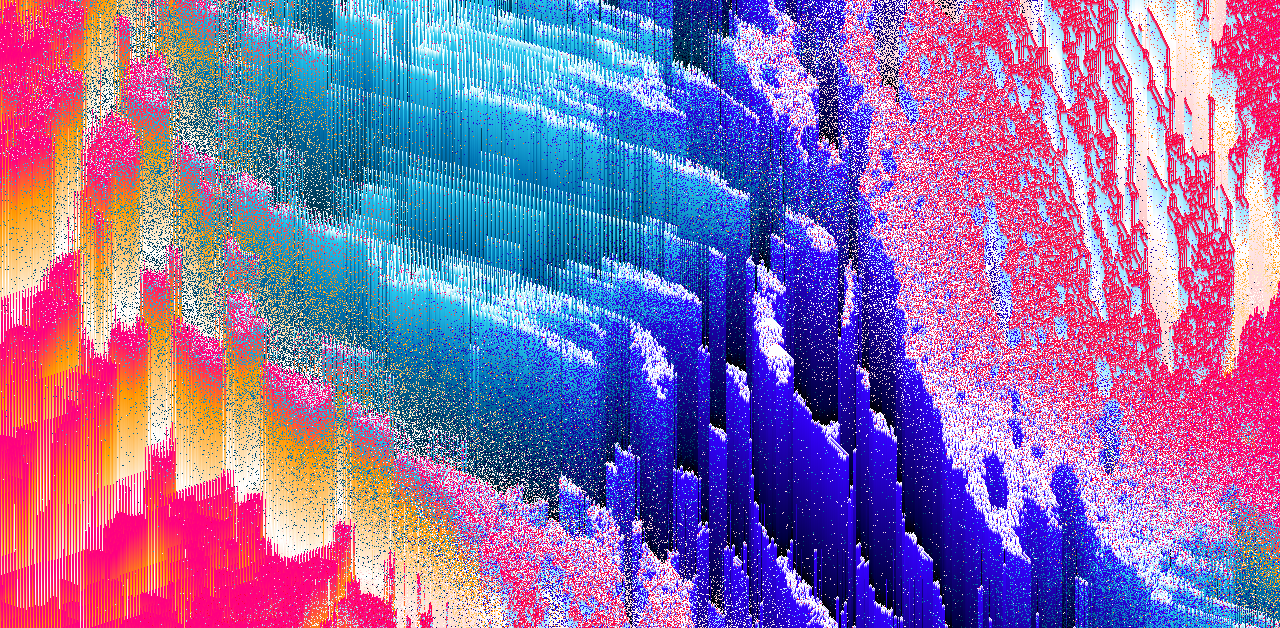
Highly customizable 1D cellular automata, shared env, multiple rules, arbitrary sized/shaped neighborhoods, short term memory, cell states etc..
The generic implementation provided by this package enables many novel and
unusual CA setups as well as coevolution of multiple CAs within a shared
environment.
This library also forms the core of **C-SCAPE**, a generative art project by the
author. Visit the [project site](https://www.fxhash.xyz/generative/slug/c-scape)
to get a better impression and overview of the multitude of possible results
(still nothing more than a small glimpse only)...
### Neighborhoods
Cell neighborhoods are defined via an arbitrary number of 2D offset vectors `[x,
y]`, where `x` coordinates are horizontal offsets and positive `y` coordinates
are used to refer to previous generations (e.g. 0 = current gen, 1 = T-1, 2 =
T-2 etc.) and thereby providing a form of short term memory for that specific
automata. Negative `y` coords will lead to cells being ignored.
### Rule encoding
Automata rules are encoded as JS `BigInt` values and are considered anisotropic
by default. If isotropy is desired, it has to be explicitly pre-encoded (out of
scope of this library). There's also built-in optional support for position
independent neighborhood encoding, only considering the number/count of non-zero
cells. An encoded rule ID and its overall magnitude is directly related and
dependent on the size and shape of its kernel config, e.g.:
```ts
kernel = [[-2, 1], [-1, 0], [0, 0], [1, 0], [2, 1]]
```
This example kernel defines a 5-cell neighborhood with a max. short term memory
of one additional previous generation (i.e. the [-2,1] and [2,1] offsets)
The rules related to this kernel have a 32 bit address space (4 billion
possibilities), due to 2^5 = 32 and each kernel offset being assigned a distinct
bit value by default, i.e. first kernel offset = 2^0, second kernel offset =
2^1, third = 2^2, fourth = 2^3, fifth = 2^4. Via the `positional` config option,
this behavior can be overridden per kernel, to achieve position-independent
kernels (with much smaller rule spaces).
Given the following example cell matrix with the center cell highlighted with
caret (`^`):
```text
T-1: 2 0 1 2 1
T-0: 0 1 0 3 0
^
```
The above example kernel will select the following values and assign bit
positions (for all non-zero cell states) to compute a summed ID:
| k index | offset | cell value | encoded |
|--------:|-----------|-----------:|---------:|
| 0 | `[-2, 1]` | 2 | 2^0 = 1 |
| 1 | `[-1, 0]` | 1 | 2^1 = 2 |
| 2 | `[0, 0]` | 0 | 0 |
| 3 | `[1, 0]` | 3 | 2^3 = 8 |
| 4 | `[2, 1]` | 1 | 2^4 = 16 |
Final encoded neighborhood sum: 1 + 2 + 8 + 16 = 27
To determine if a the current cell should be active or not in the next
generation, we now use that encoded sum as bit position to test a single bit of
the automata's rule ID, i.e. here we're testing bit 27. If that corresponding
bit is set in the rule ID, the cell's state will be increased by 1.
### Cell states
Each automata config can define a max. number of possible cell states (aka age).
Once a cell reaches the configured `numStates`, it automatically resets to zero.
This is by default, but can be overridden via the `reset` option. Conversely, if
the corresponding bit is _not_ set in the rule ID, the cell state will be zeroed
too.
### Wraparound
By default the environment is configured to be toroidal, i.e. both left/right
sides of the env are connected. The behavior can be controlled via a ctor arg
and/or at runtime via the `wrap` property.
### Masks
The `mask` array can be used to select different CA configurations for each cell
in the environment. Because this mask array is initialized to zero, only the
first CA configuration will be used for all cells in the environment by default.
It's the user's responsibility to manage the mask and select/enable other (if
any) CA configs for individual cells (usually cell ranges). The values stored in
this array correspond to the indices of the CA configurations given at
construction.
### Limits
Due to using `Uint8Arrays` for storage, only up to 256 cell states are
supported. The same limit applies to the number of CA configs given.
## Status
**STABLE** - used in production
[Search or submit any issues for this package](https://github.com/thi-ng/umbrella/issues?q=%5Bcellular%5D+in%3Atitle)
## Related packages
- [.ng/lsys](https://github.com/thi-ng/umbrella/tree/develop/packages/lsys) - Functional, extensible L-System architecture w/ support for probabilistic rules
- [.ng/pixel](https://github.com/thi-ng/umbrella/tree/develop/packages/pixel) - Typedarray integer & float pixel buffers w/ customizable formats, blitting, drawing, convolution
## Installation
```bash
yarn add .ng/cellular
```
ESM import:
```ts
import * as cell from "@thi.ng/cellular";
```
Browser ESM import:
```html
<script type="module" src="https://esm.run/@thi.ng/cellular"></script>
```
[JSDelivr documentation](https://www.jsdelivr.com/)
For Node.js REPL:
```js
const cell = await import("@thi.ng/cellular");
```
Package sizes (brotli'd, pre-treeshake): ESM: 1.45 KB
## Dependencies
- [.ng/api](https://github.com/thi-ng/umbrella/tree/develop/packages/api)
- [.ng/arrays](https://github.com/thi-ng/umbrella/tree/develop/packages/arrays)
- [.ng/checks](https://github.com/thi-ng/umbrella/tree/develop/packages/checks)
- [.ng/errors](https://github.com/thi-ng/umbrella/tree/develop/packages/errors)
- [.ng/random](https://github.com/thi-ng/umbrella/tree/develop/packages/random)
- [.ng/transducers](https://github.com/thi-ng/umbrella/tree/develop/packages/transducers)
Note: .ng/api is in _most_ cases a type-only import (not used at runtime)
## API
[Generated API docs](https://docs.thi.ng/umbrella/cellular/)
## Code examples
### Classic Wolfram
```ts
import { MultiCA1D } from "@thi.ng/cellular";
import { defIndexed, intBuffer } from "@thi.ng/pixel";
import { asPPM } from "@thi.ng/pixel-io-netpbm";
import { writeFileSync } "node:fs";
const WIDTH = 512;
const HEIGHT = 512;
// define standard 1D Wolfram CA (3-neighborhood, 2 states)
const ca = new MultiCA1D(
[
{
rule: 73,
// kernel can be imported as `WOLFRAM3`
kernel: [[-1, 0],[0, 0],[1, 0]],
states: 2,
reset: false,
},
],
WIDTH
);
// seed a single cell in center
ca.current[WIDTH/2] = 1;
// create image with indexed color model (2 cell states => 2 colors)
const img = intBuffer(WIDTH, HEIGHT, defIndexed([0xff000000, 0xffffffff]));
// compute the CA for entire image
ca.updateImage(img.data, HEIGHT);
// write as PPM file
writeFileSync("export/out.ppm", asPPM(img));
```
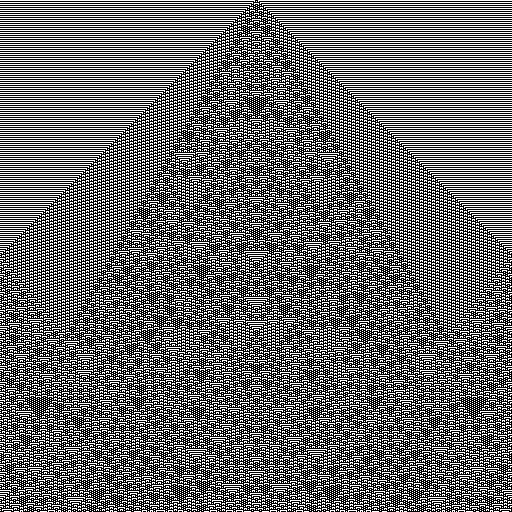
Result:
### Custom kernels & multiple rules
```ts
import { multiColorGradient, srgb } from "@thi.ng/color";
// create CA with 2 rules/kernels (5-neighborhoods) and 64 states (max age)
const ca = new MultiCA1D(
[
{
rule: 0x73ed2ac2,
// kernel can be imported as `WOLFRAM5`
kernel: [[-2, 0], [-1, 0], [0, 0], [1, 0], [2, 0]],
states: 64,
},
{
rule: 0xef14e4ca,
// kernel can be imported as `WOLFRAM5`
kernel: [[-2, 0], [-1, 0], [0, 0], [1, 0], [2, 0]],
states: 64,
}
],
WIDTH
);
// seed cells with 10% noise
ca.setNoise("cells", 0.1);
// set mask to stripe pattern to select both CAs
ca.setPattern("mask", WIDTH / 4, WIDTH / 2, 1, 0, WIDTH / 8);
// alternatively apply noise to the mask to create
// more uniformly hybrid/mixed results
// ca.setNoise("mask", 0.5);
// create color gradient to visualize the different cell states
// and wrap as indexed color model for pixel buffer below...
// references:
// https://docs.thi.ng/umbrella/color/functions/multiColorGradient.html
// https://docs.thi.ng/umbrella/pixel/functions/defIndexed.html
const fmt = defIndexed(
multiColorGradient(
{
num: ca.numStates,
stops: [
[0, srgb(1, 0, 0.5)],
[0.02, srgb(0.8, 1, 1)],
[1, srgb(1, 0.5, 0)],
],
},
false
)
);
// create image / pixel buffer using above indexed color model
const img = intBuffer(WIDTH, HEIGHT, fmt);
// compute CA for full image
ca.updateImage(img.data, HEIGHT);
// export as PPM image
writeFileSync("export/out.ppm", asPPM(img));
```
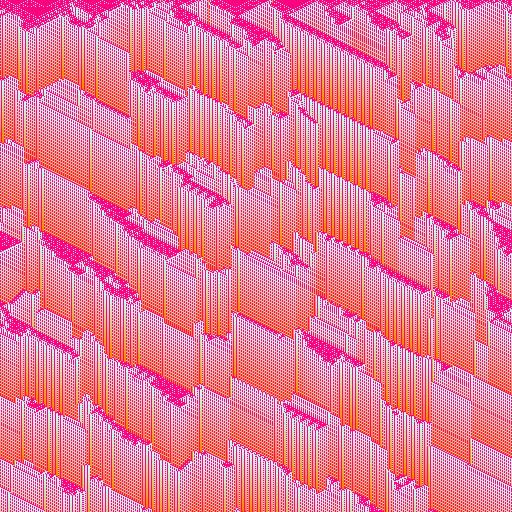
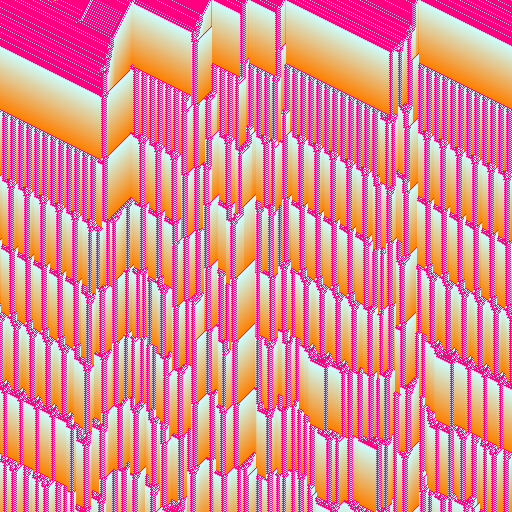
| 1st CA only | 2nd CA only |
|---------------------------------------------------------------------------------------------------|-------------------------------------------------------------------------------------------------|
|  |  |
| Hybrid (stripe pattern) | Hybrid (noise) |
| 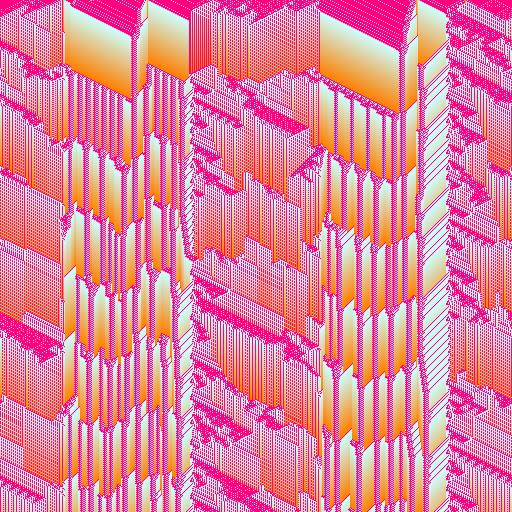 | 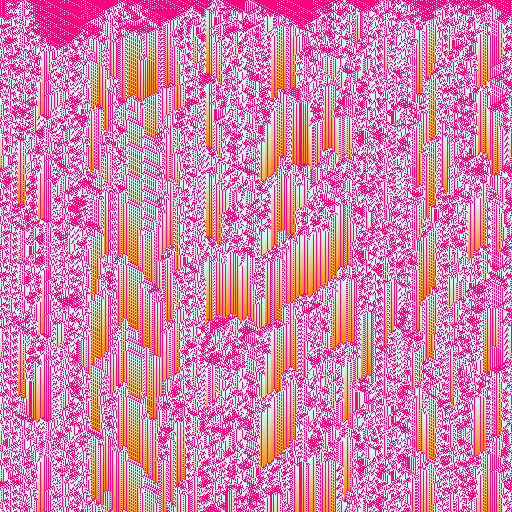 |
## Authors
- [Karsten Schmidt](https://thi.ng)
If this project contributes to an academic publication, please cite it as:
```bibtex
{thing-cellular,
title = "@thi.ng/cellular",
author = "Karsten Schmidt",
note = "https://thi.ng/cellular",
year = 2022
}
```
## License
© 2022 - 2025 Karsten Schmidt // Apache License 2.0