@nxrocks/nx-spring-boot
Version:
Nx Plugin to generate, run, package, build (and more) Spring Boot projects inside your Nx workspace
338 lines (249 loc) • 19.8 kB
Markdown
# nx-spring-boot
[](https://www.npmjs.com/package/@nxrocks/nx-spring-boot)
[](https://github.com/tinesoft/nxrocks/actions?query=workflow%3ARelease)
[](https://github.com/semantic-release/semantic-release)
> Nx Plugin to generate, run, package, build (and more) [Spring Boot](https://spring.io/projects/spring-boot) projects inside your Nx workspace
<p align="center"><img src="https://raw.githubusercontent.com/tinesoft/nxrocks/develop/images/nx-spring-boot.png" width="450"></p>
## Contents
- [Features](#features)
- [Setup](#setup)
- [Generators](#generators)
- [Executors](#executors)
- [Compatibility with Nx](#compatibility-with-nx)
## Features
Here is a list of some of the coolest features of the plugin:
- ✅ Generation of Spring Boot applications/libraries based on **Spring Initializr** API
- ✅ Building, packaging, testing, etc your Spring Boot projects
- ✅ 🆕 Built-in support for creating [**multi-modules**](recipes/README.md#creating-multi-modules-spring-boot-projects) Spring Boot projects with both `Maven` and `Gradle`
- ✅ Built-in support for code formatting using the excellent [**Spotless**](https://github.com/diffplug/spotless) plugin for `Maven` or `Gradle`
- ✅ Built-in support for **corporate proxies** (either via `--proxyUrl` or by defining environment variable `http_proxy`, `HTTP_PROXY`, `https_proxy` or `HTTPS_PROXY`)
- ✅ Integration with Nx's **dependency graph** (through `nx graph` or `nx affected:graph`): this allows you to **visualize** the dependencies of any Spring Boot's `Maven`/`Gradle` applications or libraries inside your workspace, just like Nx natively does it for JS/TS-based projects!
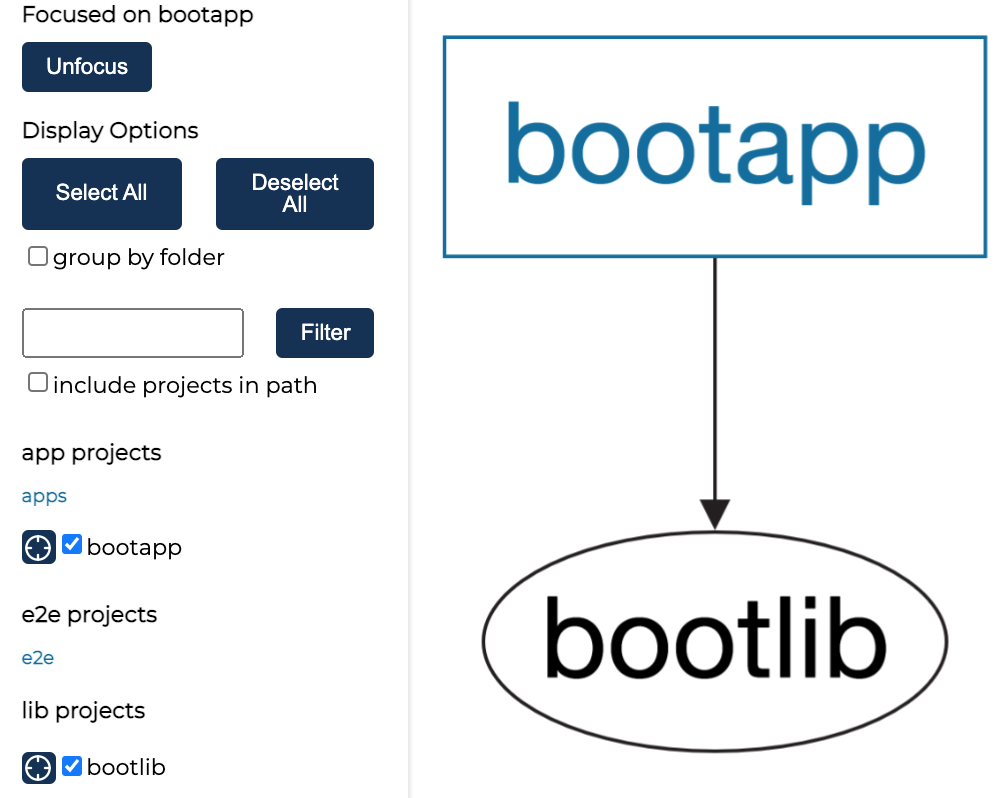
_Example of running the `nx graph` command on a workspace with 2 Spring Boot projects inside_
- ...
## Setup
<details open>
<summary>📢 ℹ️ 🆕 <b>HEADS UP!</b> New <b>simplified</b> setup since <i>October 2023</i>, with our custom <b>CLI</b>!</summary>
> You can now use our own `create-nx-spring-boot` **CLI** to easily create a Nx workspace, that comes with this plugin pre-installed!
>
> Simply run:
>
> ```
> # npm
> npx create-nx-spring-boot@latest
> # or
> # yarn
> yarn create nx-spring-boot
> ```
>
> and you are good to go‧o‧o‧o! 🚀
>
> More information here: [create-nx-spring-boot](../packages/create-nx-spring-boot/README.md)
</details>
Otherwise, this is the traditional way of setting things up:
### 1. Creating the Nx workspace
If you have not already, [create an Nx workspace](https://nx.dev/getting-started/nx-setup) with the following:
```
# npm
npx create-nx-workspace@latest
# yarn
yarn create nx-workspace
```
### 2. Installing the Plugin
Then you need to install the plugin in order to generate Spring Boot applications later on.
```
# npm
npm install @nxrocks/nx-spring-boot --save-dev
# yarn
yarn add @nxrocks/nx-spring-boot --dev
```
## Generators
This plugin is composed of 2 main **generators**:
- `project` generator
- `link` generator
### Generating Projects (`project` generator)
Simply run the `project` generator with the following command:
```
nx g @nxrocks/nx-spring-boot:project 1
```
> you can also use the following aliases to call the generator: `proj`, `new`, or `create`
You will be prompted for entering the most commonly customized generation options (like project's `groupId`, `artifactId`, `packaging`, `dependencies`, etc).
To skip the interactive prompt, or if you want to customize all non-prompted options, you can pass them along directly when running the command, as such:
```
nx g @nxrocks/nx-spring-boot:project path/to/your/app-name --optionName1 optionValue1 ... --optionNameN optionValueN
```
#### Generation Options
Here the list of available generation options :
| Arguments | Description |
| ------------- | --------------------------------- |
| `<directory>` | The directory of the new project. |
| Option | Value | Description |
| --------------------------- | ----------------------------------- | ----------------------------------------------------------------------------------------------------------------------------------------------------------------------------------------------------------- |
| `projectType` | `application` \| `library` | Type of project to generate |
| `buildSystem` | `maven-project` \| `gradle-project` | Build system |
| `packaging` | `jar` \| `war` | Packaging to use |
| `javaVersion` | `8` \| `11` \| `15` | Java version to use |
| `language` | `java` \| `groovy` \| `kotlin` | Language to use |
| `groupId` | `string` | GroupId of the project |
| `artifactId` | `string` | ArtifactId of the project |
| `packageName` | `string` | Main package name |
| `description` | `string` | Description of the project |
| `skipFormat` | `boolean` | Do not add the ability to format code (using Spotless plugin) |
| `dependencies` | `string` | List of dependencies to use (comma-separated). Go to [recipes](recipes/README.md#adding-spring-boot-dependencies) for more information |
| `transformIntoMultiModule` | `boolean` | Transform the project into a multi-module project. Go to [recipes](recipes/README.md#creating-multi-modules-spring-boot-projects) for more information |
| `addToExistingParentModule` | `boolean` | Add the project into an existing parent module project. Go to [recipes](recipes/README.md#creating-multi-modules-spring-boot-projects) for more information |
| `parentModuleName` | `string` | Name of the parent module to create or to add child project into. Go to [recipes](recipes/README.md#creating-multi-modules-spring-boot-projects) for more information |
| `keepProjectLevelWrapper` | `boolean` | Keep the `Maven` or `Gradle` wrapper files from child project (when generating a multi-module project). Go to [recipes](recipes/README.md#creating-multi-modules-spring-boot-projects) for more information |
| `springInitializerUrl` | `https://start.spring.io` | URL to the Spring Initializer instance to use |
| `proxyUrl` | | The URL of the (corporate) proxy server to use to access Spring Initializr |
| `bootVersion` | `string` | Spring Boot version to use |
| `tags` | `string` | Tags to use for linting (comma-separated) |
| `directory` | `string` | Directory where the project is placed |
> **Note:** If you are working behind a corporate proxy, you can use the `proxyUrl` option to specify the URL of that corporate proxy server.
> Otherwise, you'll get a [ETIMEDOUT error](https://github.com/tinesoft/nxrocks/issues/125) when trying to access official Spring Initializer to generate the project.
> Even simpler, you can just define environment variable `http_proxy`, `HTTP_PROXY`, `https_proxy` or `HTTPS_PROXY` globally.
### Linking Projects (`link` generator)
This generator is used to link a Spring Boot project inside the workspace (the _source_ project) with another project (the _target_ project), by adding the source project as an **implicit dependency** of the later.
Simply run the `link` generator with the following command:
```
nx g @nxrocks/nx-spring-boot:link
```
> you can also use the following aliases to call the generator: `link-project`
You will be prompted for entering the most commonly customized generation options (`sourceProjectName`, `targetProjectName`).
To skip the interactive prompt, you can pass options along directly when running the command, as such:
```
nx g @nxrocks/nx-spring-boot:link --sourceProjectName <bootapp> --targetProjectName <your-other-app>
```
or even simpler:
```
nx g @nxrocks/nx-spring-boot:link <bootapp> <your-other-app>
```
#### Generation Options
Here the list of available generation options :
| Arguments | Description |
| --------------------- | ---------------------------------------------------------------------------------------------------------------------------------------------------- |
| `<sourceProjectName>` | The name of the source(Spring-Boot) project to link from. 1st argument of the `link` generator. Can also be provided as option `--sourceProjectName` |
| `<targetProjectName>` | The name of the target project to link to. 2nd argument of the `link` generator. Can also be provided as option `--targetProjectName` |
## Executors
Once your app is generated, you can now use **executors** to manage it.
Here the list of available executors:
| Executor | Arguments | Description |
| ----------------------------- | ------------------------------------------------------------------------ | ---------------------------------------------------------------------------------------------------------------------------------------------------------------- |
| `run` \| `serve`<sup>\*</sup> | `ignoreWrapper:boolean`, `runFromParentModule:boolean`, `args: string[]` | Runs the project using either `./mvnw\|mvn spring-boot:run` or `./gradlew\|gradle bootRun` |
| `test` | `ignoreWrapper:boolean`, `runFromParentModule:boolean`, `args: string[]` | Tests the project using either `./mvnw\|mvn test` or `./gradlew\|gradle test` |
| `clean` | `ignoreWrapper:boolean`, `runFromParentModule:boolean`, `args: string[]` | Cleans the project using either `./mvnw\|mvn clean` or `./gradlew\|gradle clean` |
| `format` | `ignoreWrapper:boolean`, `runFromParentModule:boolean`, `args: string[]` | Format the project using [Spotless](https://github.com/diffplug/spotless) plugin for Maven or Gradle |
| `check-format` | `ignoreWrapper:boolean`, `runFromParentModule:boolean`, `args: string[]` | Check whether the project is well formatted using [Spotless](https://github.com/diffplug/spotless) plugin for Maven or Gradle |
| `build` | `ignoreWrapper:boolean`, `runFromParentModule:boolean`, `args: string[]` | Packages the project into an executable Jar using either `./mvnw\|mvn package` or `./gradlew\|gradle build` |
| `install` | `ignoreWrapper:boolean`, `runFromParentModule:boolean`, `args: string[]` | Installs the project's artifacts to local Maven repository (in `~/.m2/repository`) using either `./mvnw\|mvn install` or `./gradlew\|gradle publishToMavenLocal` |
| `build-info`<sup>\*</sup> | `ignoreWrapper:boolean`, `runFromParentModule:boolean`, `args: string[]` | Generates a `build-info.properties` using either `./mvnw\|mvn spring-boot:build-info` or `./gradlew\|gradle bootBuildInfo` |
| `build-image`<sup>\*</sup> | `ignoreWrapper:boolean`, `runFromParentModule:boolean`, `args: string[]` | Generates an [OCI Image](https://github.com/opencontainers/image-spec) using either `./mvnw\|mvn spring-boot:build-image` or `./gradlew\|gradle bootBuildImage` |
In order to execute the requested command, each executor will use, by default, the embedded `./mvnw` or `./gradlew` executable, that was generated alongside the project.
If you want to rely on a globally installed `mvn` or `gradle` executable instead, add the `--ignoreWrapper` option to bypass it.
This can be useful in a CI environment for example, or in a restricted environment where the binary cannot be downloaded (due to proxy/firewall limitations).
### Running the project - (`run` or `serve` Executors)
```
nx run bootapp:run
// or its shorter alias
nx serve bootapp
```
You can pass in additional arguments by editing the related section in the `workspace.json` file, as such:
```js
{
"version": 1,
"projects": {
"bootapp": {
"projectType": "application",
"root": "path/to/bootapp",
"sourceRoot": "path/to/bootapp/src",
"targets": {
"run": { // or "serve", according to your preference
"executor": "@nxrocks/nx-spring-boot:run",// or "@nxrocks/nx-spring-boot:serve", according to your preference
"options": {
"root": "path/to/bootapp",
"args": ["arg1", "arg2"]
}
}
}
}},
"cli": {
"defaultCollection": "@nx/workspace"
}
}
```
### Building the Jar or War - (`build` Executor)
```
nx build bootapp
```
> **Note:** a task dependency to `install` executor of dependent (library) projects [is added by the plugin](https://github.com/tinesoft/nxrocks/commit/68e1a5ef5ed266c65ee348c6ced022f87edb1fb7), so that Nx will automatically `install` dependent artifacts to your local Maven repository, prior to running this command. This is particulaly useful, when for example, you have a Spring Boot **application** that depends on another Spring boot **library** in the workspace. No more need to install the library yourself first!
### Install the project's artifacts to local Maven repository (in `~/.m2/repository`) - (`install` Executor)
```
nx install bootapp
```
### Building the OCI Image - (`build-image` Executor)
```
nx build-image bootapp
```
You can pass in additional arguments by editing the related section in the `workspace.json` file, as such:
```json
{
"version": 1,
"projects": {
"bootapp": {
"projectType": "application",
"root": "path/to/bootapp",
"sourceRoot": "path/to/bootapp/src",
"targets": {
"build-image": {
"executor": "@nxrocks/nx-spring-boot:build-image",
"options": {
"root": "path/to/bootapp",
"args": [
"--executor=gcr.io/paketo-buildpacks/executor:base-platform-api-0.3",
"--runImage=my-image"
]
}
}
}
}
},
"cli": {
"defaultCollection": "@nx/workspace"
}
}
```
### Testing the project - (`test` Executor)
```
nx test bootapp
```
### Cleaning the project - (`clean` Executor)
```
nx clean bootapp
```
### Formatting the project - (`format` Executor)
```
nx run bootapp:format
// or simply
nx apply-format bootapp
```
> Note: You \*cannot\*\* use the shorter `nx format bootapp` syntax here, because that would conflict with the native `format` command from Nx CLI.
### Checking the format the project - (`check-format` Executor)
```
nx check-format bootapp
```
## Compatibility with Nx
Every Nx plugin relies on the underlying Nx Workspace/DevKit it runs on. This table provides the compatibility matrix between major versions of Nx workspace and this plugin.
| Plugin Version | Nx Workspace version |
| -------------- | -------------------- |
| `>=v11.x.x` | `>=v20.x.x` |
| `>=v10.x.x` | `>=v18.x.x` |
| `>=v9.x.x` | `>=v17.x.x` |
| `>=v8.x.x` | `>=v16.x.x` |
| `>=v7.x.x` | `>=v15.8.x` |
| `>=v6.x.x` | `>=v15.x.x` |
| `>=v4.x.x` | `>=v13.8.x` |
| `>=v3.x.x` | `>=v12.6.x` |
| `>=v2.x.x` | `>=v11.x.x` |
| `<=v1.3.1` | `<=v10.x.x` |
## License
Copyright (c) 2020-present Tine Kondo. Licensed under the MIT License (MIT)