@needle-tools/engine
Version:
Needle Engine is a web-based runtime for 3D apps. It runs on your machine for development with great integrations into editors like Unity or Blender - and can be deployed onto any device! It is flexible, extensible and networking and XR are built-in.
1,161 lines (1,039 loc) • 50.4 kB
text/typescript
import { Camera as Camera3, Object3D, PerspectiveCamera, Ray, Vector2, Vector3, Vector3Like } from "three";
import { OrbitControls as ThreeOrbitControls } from "three/examples/jsm/controls/OrbitControls.js";
import { isDevEnvironment } from "../engine/debug/index.js";
import { fitCamera, FitCameraOptions } from "../engine/engine_camera.fit.js";
import { setCameraController } from "../engine/engine_camera.js";
import { Gizmos } from "../engine/engine_gizmos.js";
import { InputEventQueue, NEPointerEvent } from "../engine/engine_input.js";
import { Mathf } from "../engine/engine_math.js";
import { IRaycastOptions, RaycastOptions } from "../engine/engine_physics.js";
import { serializable } from "../engine/engine_serialization_decorator.js";
import { getTempVector, getWorldPosition } from "../engine/engine_three_utils.js";
import type { ICameraController } from "../engine/engine_types.js";
import { DeviceUtilities, getParam } from "../engine/engine_utils.js";
import { NeedleEngineWebComponent } from "../engine/webcomponents/needle-engine.js";
import { Camera } from "./Camera.js";
import { Behaviour, GameObject } from "./Component.js";
import { LookAtConstraint } from "./LookAtConstraint.js";
import { SyncedTransform } from "./SyncedTransform.js";
import { type AfterHandleInputEvent, EventSystem, EventSystemEvents } from "./ui/EventSystem.js";
import { tryGetUIComponent } from "./ui/Utils.js";
const debug = getParam("debugorbit");
const freeCam = getParam("freecam");
const debugCameraFit = getParam("debugcamerafit");
const smoothcam = getParam("smoothcam");
const disabledKeys = { LEFT: "", UP: "", RIGHT: "", BOTTOM: "" };
let defaultKeys: any = undefined;
export enum OrbitControlsEventsType {
/** Invoked with a CameraTargetReachedEvent */
CameraTargetReached = "target-reached",
}
export class CameraTargetReachedEvent extends CustomEvent<{ controls: OrbitControls, type: "camera" | "lookat" }> {
constructor(ctrls: OrbitControls, type: "camera" | "lookat") {
super(OrbitControlsEventsType.CameraTargetReached, {
detail: {
controls: ctrls,
type: type,
}
});
}
}
declare module 'three/examples/jsm/controls/OrbitControls.js' {
export interface OrbitControls {
_sphericalDelta: import("three").Spherical,
_rotateLeft: (angleInRadians: number) => void;
_rotateUp: (angleInRadians: number) => void;
_pan: (dx: number, dy: number) => void;
_dollyIn: (dollyScale: number) => void;
_dollyOut: (dollyScale: number) => void;
}
export interface OrbitControlsEventMap {
endMovement: Event;
}
}
/**
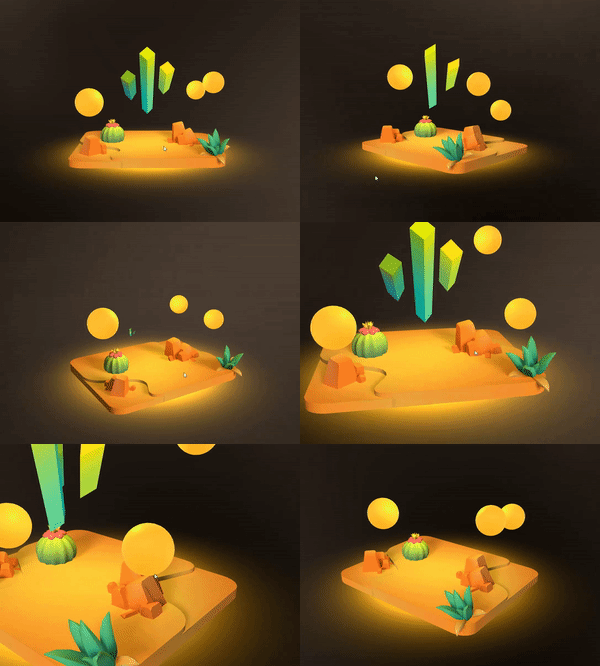
* [OrbitControls](https://engine.needle.tools/docs/api/OrbitControls) provides interactive camera control using three.js OrbitControls.
* Users can rotate, pan, and zoom the camera to explore 3D scenes.
*
* **Features:**
* - Rotation around a target point (orbit)
* - Panning to move the view
* - Zooming via scroll or pinch
* - Auto-rotation for showcases
* - Configurable angle and distance limits
* - Smooth damping for natural feel
*
* 
*
* **Access underlying controls:**
* - `controls` - The three.js OrbitControls instance
* - `controllerObject` - The object being controlled (usually the camera)
*
* **Debug options:**
* - `?debugorbit` - Log orbit control events
* - `?freecam` - Enable unrestricted camera movement
*
* @example Basic setup
* ```ts
* const orbitControls = camera.getComponent(OrbitControls);
* orbitControls.autoRotate = true;
* orbitControls.autoRotateSpeed = 2;
* ```
*
* @example Set look-at target
* ```ts
* orbitControls.setLookTargetPosition(new Vector3(0, 1, 0), true);
* // Or move both camera and target
* orbitControls.setCameraTargetPosition(new Vector3(5, 2, 5), new Vector3(0, 0, 0));
* ```
*
* @summary Camera controller using three.js OrbitControls
* @category Camera and Controls
* @group Components
* @see {@link SmoothFollow} for smooth camera following
* @see {@link Camera} for camera configuration
* @link https://threejs.org/docs/#examples/en/controls/OrbitControls
* @link https://engine.needle.tools/samples/panorama-controls alternative controls in samples
*/
export class OrbitControls extends Behaviour implements ICameraController {
/**
* @inheritdoc
*/
get isCameraController(): boolean {
return true;
}
/** The underlying three.js OrbitControls.
* See {@link https://threejs.org/docs/#examples/en/controls/OrbitControls}
* @returns {@type ThreeOrbitControls | null}
*/
public get controls() {
return this._controls;
}
/** The object being controlled by the OrbitControls (usually the camera)
* See {@link https://threejs.org/docs/#examples/en/controls/OrbitControls.object}
* @returns {@type Object3D | null}
*/
public get controllerObject(): Object3D | null {
return this._cameraObject;
}
/** Register callback when user starts interacting with the orbit controls */
public onStartInteraction(callback: Function) {
this.controls?.addEventListener("start", callback as any);
}
/** When enabled OrbitControls will automatically raycast find a look at target in start
* @default true
*/
@serializable()
autoTarget: boolean = true;
/** When enabled the scene will be automatically fitted into the camera view in onEnable
* @default false
*/
@serializable()
autoFit: boolean = false;
/** When enabled the camera can be rotated
* @default true
*/
@serializable()
enableRotate: boolean = true;
/** When enabled the camera will rotate automatically
* @default false
*/
@serializable()
autoRotate: boolean = false;
/** The speed at which the camera will rotate automatically. Will only be used when `autoRotate` is enabled
* @default 1.0
*/
@serializable()
autoRotateSpeed: number = 1.0;
/** The minimum azimuth angle in radians */
@serializable()
minAzimuthAngle: number = Infinity;
/** The maximum azimuth angle in radians */
@serializable()
maxAzimuthAngle: number = Infinity;
/** The minimum polar angle in radians
* @default 0
*/
@serializable()
minPolarAngle: number = 0;
/** The maximum polar angle in radians
* @default Math.PI
*/
@serializable()
maxPolarAngle: number = Math.PI;
/** When enabled the camera can be moved using keyboard keys. The keys are defined in the `controls.keys` property
* @default false
*/
@serializable()
enableKeys: boolean = false;
/** When enabled the camera movement will be damped
* @default true
*/
@serializable()
enableDamping: boolean = true;
/** The damping factor for the camera movement. For more information see the [three.js documentation](https://threejs.org/docs/#examples/en/controls/OrbitControls.dampingFactor)
* @default 0.1
*/
@serializable()
dampingFactor: number = 0.1;
/** When enabled the camera can be zoomed
* @default true
*/
@serializable()
enableZoom: boolean = true;
/** The minimum zoom level
* @default 0
*/
@serializable()
minZoom: number = 0;
/** The maximum zoom level
* @default Infinity
*/
@serializable()
maxZoom: number = Infinity;
/**
* Sets the zoom speed of the OrbitControls
* @default 1
*/
@serializable()
zoomSpeed: number = 1;
/**
* Set to true to enable zooming to the cursor position.
* @default false
*/
zoomToCursor: boolean = false;
/** When enabled the camera can be panned
* @default true
*/
@serializable()
enablePan: boolean = true;
/** Assigning an Object3D will make the camera look at this target's position.
* The camera will orbit around this target.
* @default null
*/
@serializable(Object3D)
lookAtTarget: Object3D | null = null;
/** When enabled the camera will continuously follow the lookAtTarget's position every frame.
* When disabled the target is only used for the initial look direction.
* @default true
*/
@serializable()
lockLookAtTarget: boolean = true;
/** The weight for the lookAtTarget interpolation
* @default 1
*/
@serializable()
lookAtConstraint01: number = 1;
// LookAtConstraint for backwards compat with old glTF files
@serializable(LookAtConstraint)
private lookAtConstraint?: LookAtConstraint;
/** If true user input interrupts the camera from animating to a target
* @default true
*/
@serializable()
allowInterrupt: boolean = true;
/** If true the camera will focus on the target when the middle mouse button is clicked */
@serializable()
middleClickToFocus: boolean = true;
/** If true the camera will focus on the target when the left mouse button is double clicked
* @default true
*/
@serializable()
doubleClickToFocus: boolean = true;
/**
* When enabled the camera will fit the scene to the camera view when the background is clicked the specified number of times within a short time
* @default 2
*/
@serializable()
clickBackgroundToFitScene: number = 2;
/**
* This is the DOM element that the OrbitControls will listen to for input events. By default this is the renderer's canvas element.
* Set this to a different element to make the OrbitControls listen to that element instead.
*/
get targetElement(): HTMLElement | null {
return this._controls?.domElement ?? this._targetElement;
}
set targetElement(value: HTMLElement | null) {
this._targetElement = value;
if (this._controls && this._controls.domElement !== value) {
this._controls.disconnect();
this._controls.domElement = value;
this._controls.connect();
}
}
private _targetElement: HTMLElement | null = null;
/**
* @internal If true debug information will be logged to the console
* @default false
*/
debugLog: boolean = false;
/**
* @deprecated use `targetLerpDuration` instead
* ~~The speed at which the camera target and the camera will be lerping to their destinations (if set via script or user input)~~
* */
get targetLerpSpeed() { return 5 }
set targetLerpSpeed(v) { this.targetLerpDuration = 1 / v; }
/** The duration in seconds it takes for the camera look ad and position lerp to reach their destination (when set via `setCameraTargetPosition` and `setLookTargetPosition`)
* @default 1
*/
@serializable()
get targetLerpDuration() { return this._lookTargetLerpDuration; }
set targetLerpDuration(v) { this._lookTargetLerpDuration = v; }
private _lookTargetLerpDuration: number = 1;
/**
* When set, the camera's look at target will be clamped within the bounds of the specified Object3D. The bounds are defined by the world position and world scale of the assigned Object3D.
* @default null
*/
@serializable(Object3D)
targetBounds: Object3D | null = null;
/**
* Rotate the camera left (or right) by the specified angle in radians.
* For positive angles the camera will rotate to the left, for negative angles it will rotate to the right.
* Tip: Use Mathf to convert between degrees and radians.
* @param angleInRadians The angle in radians to rotate the camera left
* @example
* ```typescript
* // Rotate the camera left by 0.1 radians
* orbitControls.rotateLeft(0.1);
* ```
*/
rotateLeft(angleInRadians: number) {
this._controls?._rotateLeft(angleInRadians);
}
/**
* Rotate the camera up (or down) by the specified angle in radians.
* For positive angles the camera will rotate up, for negative angles it will rotate down.
* Tip: Use Mathf to convert between degrees and radians.
* @param angleInRadians The angle in radians to rotate the camera up
* @example
* ```typescript
* // Rotate the camera up by 0.1 radians
* orbitControls.rotateUp(0.1);
* ```
*/
rotateUp(angleInRadians: number) {
this._controls?._rotateUp(angleInRadians);
}
/**
* Pan the camera by the specified amount in the x and y direction in pixels.
* @param dx The amount to pan the camera in the x direction in pixels.
* @param dy The amount to pan the camera in the y direction in pixels.
*/
pan(dx: number, dy: number) {
this._controls?._pan(dx, dy);
}
/**
* Zoom the camera in or out by the specified scale factor. The factor is applied to the current zoom radius / distance.
* If the scale is greater than 0 then the camera will zoom in, if it is less than 0 then the camera will zoom out.
* @param scale The scale factor to zoom the camera in or out. Expected range is between -1 and 1, where 0 means no zoom.
* @example
* ```typescript
* // Zoom in by 0.1
* orbitControls.zoomIn(0.1);
* // Zoom out by 0.1
* orbitControls.zoomIn(-0.1);
* ```
*/
zoomIn(scale: number) {
if (scale > 0) {
this._controls?._dollyIn(1 - scale);
}
else if (scale < 0) {
this._controls?._dollyOut(1 + scale);
}
}
private _controls: ThreeOrbitControls | null = null;
private _cameraObject: Object3D | null = null;
private _lookTargetLerpActive: boolean = false;
private _lookTargetStartPosition: Vector3 = new Vector3();
private _lookTargetEndPosition: Vector3 = new Vector3();
private _lookTargetLerp01: number = 0;
private _cameraLerpActive: boolean = false;
private _cameraStartPosition: Vector3 = new Vector3();
private _cameraEndPosition: Vector3 = new Vector3();
private _cameraLerp01: number = 0;
private _cameraLerpDuration: number = 0;
private _fovLerpActive: boolean = false;
private _fovLerpStartValue: number = 0;
private _fovLerpEndValue: number = 0;
private _fovLerp01: number = 0;
private _fovLerpDuration: number = 0;
private _inputs: number = 0;
private _enableTime: number = 0; // use to disable double click when double clicking on UI
private _startedListeningToKeyEvents: boolean = false;
private _eventSystem?: EventSystem;
private _afterHandleInputFn?: any;
private _camera: Camera | null = null;
private _syncedTransform?: SyncedTransform;
private _didSetTarget = 0;
private _didApplyLookAtTarget = false;
/** @internal */
awake(): void {
if (debug) console.debug("OrbitControls", this);
if (this.lookAtConstraint) {
console.warn("[OrbitControls] lookAtConstraint is deprecated, use lookTarget and lockLookAtTarget instead. This will be removed in a future version.");
if (!this.lookAtTarget && this.lookAtConstraint.sources?.[0]) {
this.lookAtTarget = this.lookAtConstraint.sources[0];
this.lockLookAtTarget = this.lookAtConstraint.locked;
}
}
this._didSetTarget = 0;
this._didApplyLookAtTarget = false;
this._startedListeningToKeyEvents = false;
if ((this.context.domElement as NeedleEngineWebComponent).cameraControls === false) {
this.enabled = false;
}
}
/** @internal */
start() {
this._eventSystem = EventSystem.get(this.context) ?? undefined;
if (this._eventSystem) {
this._afterHandleInputFn = this.afterHandleInput.bind(this);
this._eventSystem.addEventListener(EventSystemEvents.AfterHandleInput, this._afterHandleInputFn!);
}
}
/** @internal */
onDestroy() {
this._controls?.dispose();
this._eventSystem?.removeEventListener(EventSystemEvents.AfterHandleInput, this._afterHandleInputFn!);
}
/** @internal */
onEnable() {
this._didSetTarget = 0;
this._didApplyLookAtTarget = false;
this._enableTime = this.context.time.time;
const cameraComponent = GameObject.getComponent(this.gameObject, Camera);
this._camera = cameraComponent;
let cam = cameraComponent?.threeCamera;
if (!cam && this.gameObject instanceof PerspectiveCamera) {
cam = this.gameObject;
}
if (cam) setCameraController(cam, this, true);
if (!this._controls && cam instanceof Object3D) {
this._cameraObject = cam;
// Using the parent if possible to make it possible to disable input on the canvas
// for having HTML content behind it and still receive input
const element = this.targetElement ?? this.context.renderer.domElement;
// HACK: workaround for three orbit controls forcing an update when being created....
const mat = cam?.quaternion.clone();
this._controls = new ThreeOrbitControls(cam!, element);
cam?.quaternion.copy(mat!)
if (defaultKeys === undefined) defaultKeys = { ...this._controls.keys };
// set controls look point in front of the current camera by default
// it may be overriden by the autoTarget feature
// but if we don't do this and autoTarget is OFF then the camera will turn to look at 0 0 0 of the scene
const worldPosition = getWorldPosition(cam);
const forward = this.gameObject.worldForward;
const dist = 2.5;
const lookAt = worldPosition.clone().sub(forward.multiplyScalar(dist));
this._controls.target.copy(lookAt);
}
if (this._controls) {
if (freeCam) {
this.enablePan = true;
this.enableZoom = true;
this.middleClickToFocus = true;
if (DeviceUtilities.isMobileDevice()) this.doubleClickToFocus = true;
}
this._controls.addEventListener("start", this.onControlsChangeStarted);
this._controls.addEventListener("endMovement", this.onControlsChangeEnded);
if (!this._startedListeningToKeyEvents && this.enableKeys) {
this._startedListeningToKeyEvents = true;
this._controls.listenToKeyEvents(this.context.domElement);
}
else {
try {
this._controls.stopListenToKeyEvents();
} catch { /** this fails if we never listened to key events... */ }
}
}
this._syncedTransform = GameObject.getComponent(this.gameObject, SyncedTransform) ?? undefined;
this.context.pre_render_callbacks.push(this.__onPreRender);
this._activePointerEvents = [];
this.context.input.addEventListener("pointerdown", this._onPointerDown, { queue: InputEventQueue.Early });
this.context.input.addEventListener("pointerdown", this._onPointerDownLate, { queue: InputEventQueue.Late });
this.context.input.addEventListener("pointerup", this._onPointerUp, { queue: InputEventQueue.Early });
this.context.input.addEventListener("pointerup", this._onPointerUpLate, { queue: InputEventQueue.Late });
}
/** @internal */
onDisable() {
if (this._camera?.threeCamera) {
setCameraController(this._camera.threeCamera, this, false);
}
if (this._controls) {
this._controls.enabled = false;
this._controls.autoRotate = false;
this._controls.removeEventListener("start", this.onControlsChangeStarted);
this._controls.removeEventListener("endMovement", this.onControlsChangeEnded);
try {
this._controls.stopListenToKeyEvents();
} catch { /** this fails if we never listened to key events... */ }
this._startedListeningToKeyEvents = false;
}
this._activePointerEvents.length = 0;
this.context.input.removeEventListener("pointerdown", this._onPointerDown);
this.context.input.removeEventListener("pointerdown", this._onPointerDownLate);
this.context.input.removeEventListener("pointerup", this._onPointerUp);
this.context.input.removeEventListener("pointerup", this._onPointerUpLate);
}
private _activePointerEvents!: NEPointerEvent[];
private _lastTimeClickOnBackground: number = -1;
private _clickOnBackgroundCount: number = 0;
private _onPointerDown = (_evt: NEPointerEvent) => {
this._activePointerEvents.push(_evt);
}
private _onPointerDownLate = (evt: NEPointerEvent) => {
if (evt.used && this._controls) {
// Disabling orbit controls here because otherwise we get a slight movement when e.g. using DragControls
this._controls.enabled = false;
}
}
private _onPointerUp = (evt: NEPointerEvent) => {
// make sure we cleanup the active pointer events
for (let i = this._activePointerEvents.length - 1; i >= 0; i--) {
const registered = this._activePointerEvents[i];
if (registered.pointerId === evt.pointerId && registered.button === evt.button) {
this._activePointerEvents.splice(i, 1);
break;
}
}
if (this.clickBackgroundToFitScene > 0 && evt.isClick && evt.button === 0) {
// it's possible that we didnt raycast in this frame
if (!evt.hasRay) {
evt.intersections.push(...this.context.physics.raycast());
}
if (evt.intersections.length <= 0) {
const dt = this.context.time.time - this._lastTimeClickOnBackground;
this._lastTimeClickOnBackground = this.context.time.time;
if (this.clickBackgroundToFitScene <= 1 || dt < this.clickBackgroundToFitScene * .15) {
this._clickOnBackgroundCount += 1;
if (this._clickOnBackgroundCount >= this.clickBackgroundToFitScene - 1) {
this.autoRotate = false;
this.fitCamera({
objects: this.context.scene,
immediate: false,
});
}
}
else {
this._clickOnBackgroundCount = 0;
}
}
if (debug) console.log(this.clickBackgroundToFitScene, evt.intersections.length, this._clickOnBackgroundCount)
}
};
private _onPointerUpLate = (evt: NEPointerEvent) => {
if (this.doubleClickToFocus && evt.isDoubleClick && !evt.used) {
this.setTargetFromRaycast();
}
// Automatically update the camera focus
// else if (!evt.used && this.autoTarget) {
// this.updateTargetNow();
// }
};
private updateTargetNow(options?: IRaycastOptions) {
if (debug) console.warn("OrbitControls: updateTargetNow is using raycasting to update the target immediately. This can be expensive and should be used with caution.", options);
const ray = new Ray(this._cameraObject?.worldPosition, this._cameraObject?.worldForward.multiplyScalar(-1));
const hits = this.context.physics.raycastFromRay(ray, options);
const hit = hits.length > 0 ? hits[0] : undefined;
if (hit && hit.distance > this.minZoom && hit.distance < this.maxZoom) {
if (debug) Gizmos.DrawWireSphere(hit.point, 0.1, 0xff0000, 2);
this._controls?.target.copy(hits[0].point);
}
else {
if (debug) console.log("OrbitControls: No hit found when updating target", { hits: [...hits] });
}
}
private _orbitStartAngle: number = 0;
private _zoomStartDistance: number = 0;
private onControlsChangeStarted = () => {
if (debug) console.debug("OrbitControls: Change started");
if (this._controls) {
this._orbitStartAngle = this._controls.getAzimuthalAngle() + this._controls.getPolarAngle();
this._zoomStartDistance = this._controls.getDistance();
}
if (this._syncedTransform) {
this._syncedTransform.requestOwnership();
}
}
private onControlsChangeEnded = () => {
if (debug) console.debug("OrbitControls: Change ended", { autoTarget: this.autoTarget });
if (this._controls) {
if (this.autoTarget) {
const newAngle = this._controls.getAzimuthalAngle() + this._controls.getPolarAngle();
const deltaAngle = newAngle - this._orbitStartAngle;
// TODO: "just zoom" probably shouldnt update the target either, unless zoomToCursor is enabled
if (Math.abs(deltaAngle) < .01) {
if (debug) console.debug("OrbitControls: Update target", { deltaAngle });
this.updateTargetNow({ allowSlowRaycastFallback: false });
}
else if (debug) console.debug("OrbitControls: No target update", { deltaAngle });
}
}
}
private _shouldDisable: boolean = false;
private afterHandleInput(evt: CustomEvent<AfterHandleInputEvent>) {
if (evt.detail.args.pointerId === 0) {
if (evt.detail.args.isDown) {
if (this._controls && this._eventSystem) {
this._shouldDisable = this._eventSystem.hasActiveUI;
}
}
else if (!evt.detail.args.isPressed || evt.detail.args.isUp) {
this._shouldDisable = false;
}
}
}
onPausedChanged(isPaused: boolean): void {
if (!this._controls) return;
if (isPaused) this._controls.enabled = false;
}
/** @internal */
onBeforeRender() {
if (!this._controls) return;
if (this._cameraObject !== this.context.mainCamera) {
this._controls.enabled = false;
return;
}
this._controls.enabled = true;
// Interrupt programmatic transitions on meaningful new user interaction:
// - Middle/right button down (always intentional camera control)
// - Mouse wheel (zoom intent)
// - Left button drag start: getPointerDown(0) with a position delta — a bare click
// without movement shouldn't cancel an animation, but starting to drag should.
// Using getPointerDown (not getPointerPressed) ensures we only interrupt once at
// drag onset, not continuously every frame during a drag.
const leftDragStart = this.context.input.getPointerDown(0) && (this.context.input.getPointerPositionDelta(0)?.length() || 0) > .1;
if (this.context.input.getPointerDown(1) || this.context.input.getPointerDown(2) || this.context.input.mouseWheelChanged || leftDragStart) {
this._inputs += 1;
}
if (this._inputs > 0 && this.allowInterrupt) {
// if a user has disabled rotation but enabled auto rotate we don't want to change it when we receive input
if (this.enableRotate) {
this.autoRotate = false;
}
this._cameraLerpActive = false;
this._lookTargetLerpActive = false;
}
this._inputs = 0;
if (this.autoTarget) {
// we want to wait one frame so all matrixWorlds are updated
// otherwise raycasting will not work correctly
if (this._didSetTarget++ === 0) {
const camGo = GameObject.getComponent(this.gameObject, Camera);
if (camGo && !this.setLookTargetFromConstraint()) {
if (this.debugLog)
console.log("NO TARGET");
const worldPosition = getWorldPosition(camGo.threeCamera);
// Handle case where the camera is in 0 0 0 of the scene
// if the look at target is set to the camera position we can't move at all anymore
const distanceToCenter = Math.max(.01, worldPosition.length());
const forward = new Vector3(0, 0, -distanceToCenter).applyMatrix4(camGo.threeCamera.matrixWorld);
if (debug) Gizmos.DrawLine(worldPosition, forward, 0x5555ff, 10)
this.setLookTargetPosition(forward, true);
}
if (!this.setLookTargetFromConstraint()) {
const opts = new RaycastOptions();
// center of the screen:
opts.screenPoint = new Vector2(0, 0);
opts.lineThreshold = 0.1;
const hits = this.context.physics.raycast(opts);
if (hits.length > 0) {
this.setLookTargetPosition(hits[0].point, true);
}
if (debugCameraFit)
console.log("OrbitControls hits", ...hits);
}
}
}
const focusAtPointer = (this.middleClickToFocus && this.context.input.getPointerClicked(1));
if (focusAtPointer) {
this.setTargetFromRaycast();
}
if (this._lookTargetLerpActive || this._cameraLerpActive || this._fovLerpActive) {
// lerp the camera
if (this._cameraLerpActive && this._cameraObject) {
this._cameraLerp01 += this.context.time.deltaTime / this._cameraLerpDuration;
if (this._cameraLerp01 >= 1) {
this._cameraObject.position.copy(this._cameraEndPosition);
this._cameraLerpActive = false;
this.dispatchEvent(new CameraTargetReachedEvent(this, "camera"));
}
else {
const t = Mathf.easeInOutCubic(this._cameraLerp01);
this._cameraObject.position.lerpVectors(this._cameraStartPosition, this._cameraEndPosition, t);
}
}
// lerp the look target
if (this._lookTargetLerpActive) {
this._lookTargetLerp01 += this.context.time.deltaTime / this._lookTargetLerpDuration;
if (this._lookTargetLerp01 >= 1) {
this.lerpLookTarget(this._lookTargetEndPosition, this._lookTargetEndPosition, 1);
this._lookTargetLerpActive = false;
this.dispatchEvent(new CameraTargetReachedEvent(this, "lookat"));
} else {
const t = Mathf.easeInOutCubic(this._lookTargetLerp01);
this.lerpLookTarget(this._lookTargetStartPosition, this._lookTargetEndPosition, t);
}
}
// lerp the fov
if (this._fovLerpActive && this._cameraObject) {
const cam = this._cameraObject as PerspectiveCamera;
this._fovLerp01 += this.context.time.deltaTime / this._fovLerpDuration;
if (this._fovLerp01 >= 1) {
cam.fov = this._fovLerpEndValue;
this._fovLerpActive = false;
} else {
const t = Mathf.easeInOutCubic(this._fovLerp01);
cam.fov = Mathf.lerp(this._fovLerpStartValue, this._fovLerpEndValue, t);
}
cam.updateProjectionMatrix();
}
}
if (this.targetBounds) {
// #region target bounds
const boundsCenter = this.targetBounds.worldPosition;
const boundsHalfSize = getTempVector(this.targetBounds.worldScale).multiplyScalar(0.5);
const min = getTempVector(boundsCenter).sub(boundsHalfSize);
const max = getTempVector(boundsCenter).add(boundsHalfSize);
if (this._lookTargetLerpActive) {
// During a programmatic transition (fitCamera / setLookTargetPosition with immediate: false),
// only clamp the destination. The look-target lerp (above) handles moving _controls.target
// towards the endpoint — we must not fight it by also lerping _controls.target here.
this._lookTargetEndPosition.clamp(min, max);
}
else {
// Interactive use (pan/orbit): smoothly push the target back into bounds
const targetVector = this._controls.target;
const newTarget = getTempVector(targetVector).clamp(min, max);
const duration = .1;
if (duration <= 0) targetVector.copy(newTarget);
else targetVector.lerp(newTarget, Math.min(1, this.context.time.deltaTime / duration));
}
if (debug) {
Gizmos.DrawWireBox(boundsCenter, boundsHalfSize.multiplyScalar(2), 0xffaa00);
}
}
if (this._controls) {
if (this.debugLog) this._controls.domElement = this.context.renderer.domElement;
const viewZoomFactor = 1 / (this.context.focusRectSettings?.zoom || 1);
this._controls.enabled = !this._shouldDisable && this._camera === this.context.mainCameraComponent && !this.context.isInXR && !this._activePointerEvents.some(e => e.used);
this._controls.keys = this.enableKeys ? defaultKeys : disabledKeys;
this._controls.autoRotate = this.autoRotate;
this._controls.autoRotateSpeed = this.autoRotateSpeed;
this._controls.enableZoom = this.enableZoom;
this._controls.zoomSpeed = this.zoomSpeed;
this._controls.zoomToCursor = this.zoomToCursor;
this._controls.enableDamping = this.enableDamping;
this._controls.dampingFactor = this.dampingFactor;
this._controls.enablePan = this.enablePan;
this._controls.panSpeed = viewZoomFactor;
this._controls.enableRotate = this.enableRotate;
this._controls.minAzimuthAngle = this.minAzimuthAngle;
this._controls.maxAzimuthAngle = this.maxAzimuthAngle;
this._controls.minPolarAngle = this.minPolarAngle;
this._controls.maxPolarAngle = this.maxPolarAngle;
// set the min/max zoom if it's not a free cam
if (!freeCam) {
if (this._camera?.threeCamera?.type === "PerspectiveCamera") {
this._controls.minDistance = this.minZoom;
this._controls.maxDistance = this.maxZoom;
this._controls.minZoom = 0;
this._controls.maxZoom = Infinity;
}
else {
this._controls.minDistance = 0;
this._controls.maxDistance = Infinity;
this._controls.minZoom = this.minZoom;
this._controls.maxZoom = this.maxZoom;
}
}
if (typeof smoothcam === "number" || smoothcam === true) {
this._controls.enableDamping = true;
const factor = typeof smoothcam === "number" ? smoothcam : .99;
this._controls.dampingFactor = Math.max(.001, 1 - Math.min(1, factor));
}
if (!this.allowInterrupt) {
if (this._lookTargetLerpActive) {
this._controls.enablePan = false;
}
if (this._cameraLerpActive) {
this._controls.enableRotate = false;
this._controls.autoRotate = false;
}
if (this._lookTargetLerpActive || this._cameraLerpActive) {
this._controls.enableZoom = false;
}
}
// this._controls.zoomToCursor = this.zoomToCursor;
if (!this.context.isInXR) {
if (!freeCam && this.lookAtTarget && !this._lookTargetLerpActive) {
if (this.lockLookAtTarget) {
this.setLookTargetFromConstraint(this.lookAtConstraint01);
}
else if (!this._didApplyLookAtTarget) {
this._didApplyLookAtTarget = true;
this.setLookTargetFromConstraint(1);
}
}
this._controls.update(this.context.time.deltaTime);
if (debug) {
const distance = this._controls.getDistance();
Gizmos.DrawWireSphere(this._controls.target, 0.01 * distance, 0x00ff00);
}
}
}
}
private __onPreRender = () => {
// We call this only once when the camera becomes active and use the engine pre_render_callbacks because they are run
// after all scripts have been executed
const index = this.context.pre_render_callbacks.indexOf(this.__onPreRender);
if (index >= 0) {
this.context.pre_render_callbacks.splice(index, 1);
}
if (this.autoFit) {
// we don't want to autofit again if the component is disabled and re-enabled
this.autoFit = false;
this.fitCamera({
centerCamera: "y",
immediate: true,
objects: this.scene.children,
})
}
}
/**
* Sets camera target position and look direction using a raycast in forward direction of the object.
*
* @param source The object to raycast from. If a camera is passed in the camera position will be used as the source.
* @param immediateOrDuration If true the camera target will move immediately to the new position, otherwise it will lerp. If a number is passed in it will be used as the duration of the lerp.
*
* This is useful for example if you want to align your camera with an object in your scene (or another camera). Simply pass in this other camera object
* @returns true if the target was set successfully
*/
public setCameraAndLookTarget(source: Object3D | Camera, immediateOrDuration: number | boolean = false): boolean {
if (!source) {
if (isDevEnvironment() || debug) console.warn("[OrbitControls] setCameraAndLookTarget target is null");
return false;
}
if (!(source instanceof Object3D) && !(source instanceof Camera)) {
if (isDevEnvironment() || debug) console.warn("[OrbitControls] setCameraAndLookTarget target is not an Object3D or Camera");
return false;
}
if (source instanceof Camera) {
source = source.gameObject;
}
const worldPosition = source.worldPosition;
const forward = source.worldForward;
// The camera render direction is -Z. When a camera is passed in then we'll take the view direction OR the object Z forward direction.
if (source instanceof Camera3) {
if (debug) console.debug("[OrbitControls] setCameraAndLookTarget flip forward direction for camera");
forward.multiplyScalar(-1);
}
const ray = new Ray(worldPosition, forward);
if (debug) Gizmos.DrawRay(ray.origin, ray.direction, 0xff0000, 10);
if (!this.setTargetFromRaycast(ray, immediateOrDuration)) {
this.setLookTargetPosition(ray.at(2, getTempVector()), immediateOrDuration);
}
this.setCameraTargetPosition(worldPosition, immediateOrDuration);
return true;
}
/** Moves the camera to position smoothly.
* @param position The position in local space of the controllerObject to move the camera to. If null the camera will stop lerping to the target.
* @param immediateOrDuration If true the camera will move immediately to the new position, otherwise it will lerp. If a number is passed in it will be used as the duration of the lerp.
*/
public setCameraTargetPosition(position?: Object3D | Vector3Like | null, immediateOrDuration: boolean | number = false) {
if (!position) return;
if (position instanceof Object3D) {
position = getWorldPosition(position) as Vector3;
}
if (!this._cameraEndPosition) this._cameraEndPosition = new Vector3();
this._cameraEndPosition.copy(position);
if (immediateOrDuration === true) {
this._cameraLerpActive = false;
if (this._cameraObject) {
this._cameraObject.position.copy(this._cameraEndPosition);
}
}
else if (this._cameraObject) {
this._cameraLerpActive = true;
this._cameraLerp01 = 0;
this._cameraStartPosition.copy(this._cameraObject?.position);
if (typeof immediateOrDuration === "number") {
this._cameraLerpDuration = immediateOrDuration;
}
else this._cameraLerpDuration = this.targetLerpDuration;
}
}
// public setCameraTargetRotation(rotation: Vector3 | Euler | Quaternion, immediateOrDuration: boolean | number = false): void {
// if (!this._cameraObject) return;
// if (typeof immediateOrDuration === "boolean") immediateOrDuration = immediateOrDuration ? 0 : this.targetLerpDuration;
// const ray = new Ray(this._cameraObject.worldPosition, getTempVector(0, 0, 1));
// // if the camera is in the middle of lerping we use the end position for the raycast
// if (immediateOrDuration > 0 && this._cameraEndPosition && this._cameraLerpActive) {
// ray.origin = getTempVector(this._cameraEndPosition)
// }
// if (rotation instanceof Vector3) {
// rotation = new Euler().setFromVector3(rotation);
// }
// if (rotation instanceof Euler) {
// rotation = new Quaternion().setFromEuler(rotation);
// }
// ray.direction.applyQuaternion(rotation);
// ray.direction.multiplyScalar(-1);
// const hits = this.context.physics.raycastFromRay(ray);
// if (hits.length > 0) {
// this.setCameraTargetPosition(hits[0].point, immediateOrDuration);
// }
// else {
// this.setLookTargetPosition(ray.at(2, getTempVector()));
// }
// }
/** True while the camera position is being lerped */
get cameraLerpActive() { return this._cameraLerpActive; }
/** Call to stop camera position lerping */
public stopCameraLerp() {
this._cameraLerpActive = false;
}
public setFieldOfView(fov: number | undefined, immediateOrDuration: boolean | number = false) {
if (!this._controls) return;
if (typeof fov !== "number") return;
const cam = this._camera?.threeCamera as PerspectiveCamera;
if (!cam) return;
if (immediateOrDuration === true) {
cam.fov = fov;
}
else {
this._fovLerpActive = true;
this._fovLerp01 = 0;
this._fovLerpStartValue = cam.fov;
this._fovLerpEndValue = fov;
if (typeof immediateOrDuration === "number") {
this._fovLerpDuration = immediateOrDuration;
}
else this._fovLerpDuration = this.targetLerpDuration;
}
// if (this.context.mainCameraComponent) this.context.mainCameraComponent.fieldOfView = fov;
}
/** Moves the camera look-at target to a position smoothly.
* @param position The position in world space to move the camera target to. If null the camera will stop lerping to the target.
* @param immediateOrDuration If true the camera target will move immediately to the new position, otherwise it will lerp. If a number is passed in it will be used as the duration of the lerp.
*/
public setLookTargetPosition(position: Object3D | Vector3Like | null = null, immediateOrDuration: boolean | number = false) {
if (!this._controls) return;
if (!position) return
if (position instanceof Object3D) {
position = getWorldPosition(position) as Vector3;
}
this._lookTargetEndPosition.copy(position);
// if a user calls setLookTargetPosition we don't want to perform autoTarget in onBeforeRender (and override whatever the user set here)
this._didSetTarget++;
if (debug) {
console.warn("OrbitControls: setLookTargetPosition", position, immediateOrDuration);
const distance = this._controls.getDistance();
Gizmos.DrawWireSphere(this._lookTargetEndPosition, 0.01 * distance, 0xff5500, 2);
}
if (immediateOrDuration === true) {
this.lerpLookTarget(this._lookTargetEndPosition, this._lookTargetEndPosition, 1);
}
else {
this._lookTargetLerpActive = true;
this._lookTargetLerp01 = 0;
this._lookTargetStartPosition.copy(this._controls.target);
if (typeof immediateOrDuration === "number") {
this._lookTargetLerpDuration = immediateOrDuration;
}
else this._lookTargetLerpDuration = this.targetLerpDuration;
}
}
/** True while the camera look target is being lerped */
get lookTargetLerpActive() { return this._lookTargetLerpActive; }
/** Call to stop camera look target lerping */
public stopLookTargetLerp() {
this._lookTargetLerpActive = false;
}
/** Sets the look at target from the assigned lookAtTarget Object3D
* @param t The interpolation factor between the current look at target and the new target
*/
private setLookTargetFromConstraint(t: number = 1): boolean {
if (!this._controls) return false;
if (!this.lookAtTarget) return false;
this.lookAtTarget.getWorldPosition(this._lookTargetEndPosition);
this.lerpLookTarget(this._controls.target, this._lookTargetEndPosition, t);
return true;
}
private lerpLookTarget(start: Vector3, position: Vector3, t: number) {
if (!this._controls) return;
if (t >= 1) this._controls.target.copy(position);
else this._controls.target.lerpVectors(start, position, t);
if (this.lookAtTarget && this.lockLookAtTarget) this.lookAtTarget.worldPosition = this._controls.target;
}
private setTargetFromRaycast(ray?: Ray, immediateOrDuration: number | boolean = false): boolean {
if (!this.controls) return false;
const rc = ray ? this.context.physics.raycastFromRay(ray) : this.context.physics.raycast();
for (const hit of rc) {
if (hit.distance > 0 && GameObject.isActiveInHierarchy(hit.object)) {
const uiComponent = tryGetUIComponent(hit.object);
if (uiComponent) {
const canvas = uiComponent.canvas;
if (canvas?.screenspace) {
break;
}
}
this.setLookTargetPosition(hit.point, immediateOrDuration);
return true;
}
}
return false;
}
// Adapted from https://discourse.threejs.org/t/camera-zoom-to-fit-object/936/24
// Slower but better implementation that takes bones and exact vertex positions into account: https://github.com/google/model-viewer/blob/04e900c5027de8c5306fe1fe9627707f42811b05/packages/model-viewer/src/three-components/ModelScene.ts#L321
/**
* Fits the camera to show the objects provided (defaults to the scene if no objects are passed in)
* @param options The options for fitting the camera. Use to provide objects to fit to, fit direction and size and other settings.
*/
fitCamera(options?: OrbitFitCameraOptions);
// Deprecated overload commented out: it accepted Object3D as first arg, which caused
// TypeScript autocomplete to show Object3D properties (position, worldPosition, etc.)
// instead of OrbitFitCameraOptions. The implementation still handles Object3D at runtime
// for backwards-compat — use fitCamera({ objects: [...] }) instead.
// fitCamera(objects?: Object3D | Array<Object3D>, options?: Omit<OrbitFitCameraOptions, "objects">);
fitCamera(objectsOrOptions?: Object3D | Array<Object3D> | OrbitFitCameraOptions, options?: OrbitFitCameraOptions): void {
let objects: Object3D | Array<Object3D> | undefined = undefined;
// If the user passed in an array as first argument
if (Array.isArray(objectsOrOptions)) {
objects = objectsOrOptions;
}
// If the user passed in an object as first argument
else if (objectsOrOptions && "type" in objectsOrOptions) {
objects = objectsOrOptions;
}
// If the user passed in an object as first argument and options as second argument
else if (objectsOrOptions && typeof objectsOrOptions === "object") {
if (!(objectsOrOptions instanceof Object3D) && !Array.isArray(objectsOrOptions)) {
options = objectsOrOptions;
objects = options.objects;
}
}
// Ensure objects are setup correctly
if (objects && !Array.isArray(objects)) {
objects = [objects];
}
if (!Array.isArray(objects) || objects && objects.length <= 0) {
objects = this.context.scene.children;
}
// Make sure there's anything to fit to
if (!Array.isArray(objects) || objects.length <= 0) {
console.warn("No objects to fit camera to...");
return;
}
const res = fitCamera({
objects: [...objects],
...options,
autoApply: false,
context: this.context,
camera: this._cameraObject as Camera3,
currentZoom: this._controls?.getDistance() || undefined,
minZoom: this.minZoom,
maxZoom: this.maxZoom,
});
if (!res) return;