@needle-tools/engine
Version:
Needle Engine is a web-based runtime for 3D apps. It runs on your machine for development with great integrations into editors like Unity or Blender - and can be deployed onto any device! It is flexible, extensible and networking and XR are built-in.
240 lines (214 loc) • 10.4 kB
text/typescript
import { Object3D, Quaternion, Vector3 } from "three";
import { isDevEnvironment, showBalloonWarning } from "../engine/debug/index.js";
import { WaitForSeconds } from "../engine/engine_coroutine.js";
import { InstantiateOptions } from "../engine/engine_gameobject.js";
import { InstantiateIdProvider } from "../engine/engine_networking_instantiate.js";
import { serializable } from "../engine/engine_serialization_decorator.js";
import { Behaviour, GameObject } from "./Component.js";
import { DragControls, DragMode } from "./DragControls.js";
import { SyncedTransform } from "./SyncedTransform.js";
import { type IPointerEventHandler, PointerEventData } from "./ui/PointerEvents.js";
import { ObjectRaycaster } from "./ui/Raycaster.js";
/**
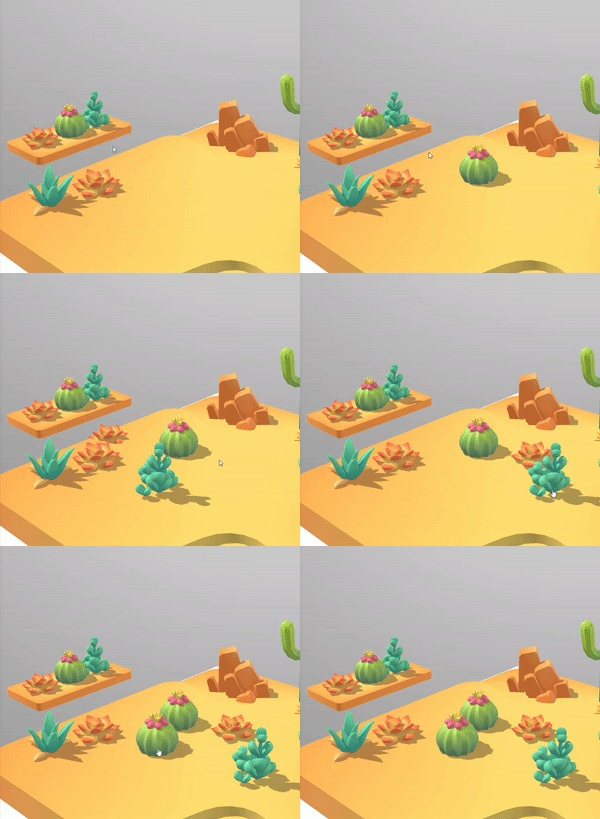
* The [Duplicatable](https://engine.needle.tools/docs/api/Duplicatable) component creates clones of a GameObject when clicked/tapped/dragged.
* Perfect for spawning objects, creating drag-and-drop inventories, or multiplayer object creation.
*
* 
*
* **How it works:**
* - When the user clicks on this object, it creates a clone of the assigned `object`
* - The clone is automatically set up with {@link DragControls} so users can drag it
* - If networking is enabled, clones are synced via {@link SyncedTransform}
* - Rate limiting prevents spam (controlled by `limitCount`)
*
* **Setup tips:**
* - Assign `object` to a template object (it will be hidden and used as source)
* - If `object` is not assigned, the component's own GameObject is used as template
* - Add an {@link ObjectRaycaster} to enable pointer detection (added automatically if missing)
*
* @example Basic duplicatable button
* ```ts
* const duplicatable = spawnButton.addComponent(Duplicatable);
* duplicatable.object = templateObject; // Object to clone
* duplicatable.parent = spawnContainer; // Where to place clones
* duplicatable.limitCount = 10; // Max 10 per second
* ```
*
* @summary Duplicates a GameObject on pointer events
* @category Interactivity
* @group Components
* @see {@link DragControls} for dragging the duplicated objects
* @see {@link SyncedTransform} for networking support
* @see {@link GameObject.instantiateSynced} for the underlying instantiation
* @link https://engine.needle.tools/samples/collaborative-sandbox/
*/
export class Duplicatable extends Behaviour implements IPointerEventHandler {
/**
* Parent object for spawned duplicates.
* If not set, duplicates are parented to this GameObject's parent.
*/
parent: GameObject | null = null;
/**
* Template object to duplicate. This object will be hidden and used as the source for clones.
* If not assigned, this GameObject itself is used as the template.
*/
object: GameObject | null = null;
/**
* Maximum duplications allowed per second to prevent spam.
* The counter decreases by 1 each second.
* @default 60
*/
limitCount: number = 60;
private _currentCount = 0;
private _startPosition: Vector3 | null = null;
private _startQuaternion: Quaternion | null = null;
start(): void {
this._currentCount = 0;
this._startPosition = null;
this._startQuaternion = null;
if (!this.object) {
this.object = this.gameObject;
}
if (this.object) {
if (this.object === this.gameObject) {
// console.error("Can not duplicate self");
// return;
const instanceIdProvider = new InstantiateIdProvider(this.guid);
this.object = GameObject.instantiate(this.object, { idProvider: instanceIdProvider, keepWorldPosition: false, });
const duplicatable = GameObject.getComponent(this.object, Duplicatable);
duplicatable?.destroy();
let dragControls = this.object.getComponentInChildren(DragControls);
if (!dragControls) {
dragControls = this.object.addComponent(DragControls, {
dragMode: DragMode.SnapToSurfaces
});
dragControls.guid = instanceIdProvider.generateUUID();
}
let syncedTransfrom = GameObject.getComponent(dragControls.gameObject, SyncedTransform);
if (!syncedTransfrom) {
syncedTransfrom = dragControls.gameObject.addComponent(SyncedTransform);
syncedTransfrom.guid = instanceIdProvider.generateUUID();
}
}
this.object.visible = false;
// legacy – DragControls was required for duplication and so often the component is still there; we work around that by disabling it here
const dragControls = this.gameObject.getComponent(DragControls);
if (dragControls) {
// if (isDevEnvironment()) console.warn(`Please remove DragControls from \"${dragControls.name}\": it's not needed anymore when the object also has a Duplicatable component`);
dragControls.enabled = false;
}
// when this is in a moveable parent in multiuser scenario somehow the object position gets an offset and might stay that way
// this is just a workaround to set the object position before duplicating
this._startPosition = this.object.position?.clone() ?? new Vector3(0, 0, 0);
this._startQuaternion = this.object.quaternion?.clone() ?? new Quaternion(0, 0, 0, 1);
}
if (!this.gameObject.getComponentInParent(ObjectRaycaster))
this.gameObject.addComponent(ObjectRaycaster);
}
onEnable(): void {
this.startCoroutine(this.cloneLimitIntervalFn());
}
private _forwardPointerEvents: Map<Object3D, DragControls> = new Map();
onPointerEnter(args: PointerEventData) {
if (args.used) return;
if (!this.object) return;
if (!this.context.connection.allowEditing) return;
if (args.button !== 0) return;
this.context.input.setCursor("pointer");
}
onPointerExit(args: PointerEventData) {
if (args.used) return;
if (!this.object) return;
if (!this.context.connection.allowEditing) return;
if (args.button !== 0) return;
this.context.input.unsetCursor("pointer");
}
/** @internal */
onPointerDown(args: PointerEventData) {
if (args.used) return;
if (!this.object) return;
if (!this.context.connection.allowEditing) return;
if (args.button !== 0) return;
const res = this.handleDuplication();
if (res) {
const dragControls = GameObject.getComponent(res, DragControls);
if (!dragControls) {
if (isDevEnvironment()) console.warn(`Duplicated object (${res.name}) does not have DragControls`);
} else {
dragControls.onPointerDown(args);
this._forwardPointerEvents.set(args.event.space, dragControls);
}
}
else {
if (this._currentCount >= this.limitCount) {
console.warn(`[Duplicatable] Limit of ${this.limitCount} objects created within a few seconds reached. Please wait a moment before creating more objects.`);
}
else {
console.warn(`[Duplicatable] Could not duplicate object.`);
}
}
}
/** @internal */
onPointerUp(args: PointerEventData) {
if (args.used) return;
const dragControls = this._forwardPointerEvents.get(args.event.space);
if (dragControls) {
dragControls.onPointerUp(args);
this._forwardPointerEvents.delete(args.event.space);
}
}
private *cloneLimitIntervalFn() {
while (this.activeAndEnabled && !this.destroyed) {
if (this._currentCount > 0) {
this._currentCount -= 1;
}
else if (this._currentCount < 0) {
this._currentCount = 0;
}
yield WaitForSeconds(1);
}
}
private handleDuplication(): Object3D | null {
if (!this.object) return null;
if (this.limitCount > 0 && this._currentCount >= this.limitCount) return null;
if (this.object === this.gameObject) return null;
if (GameObject.isDestroyed(this.object)) {
this.object = null;
return null;
}
if (this.object.matrixAutoUpdate === false) {
this.object.updateMatrix();
if (isDevEnvironment()) {
console.warn(`Object "${this.object.name}" has matrixAutoUpdate disabled. This can cause duplicated objects to have incorrect position/rotation/scale. Consider enabling matrixAutoUpdate or calling updateMatrix() before duplication.`);
showBalloonWarning("Duplicatable: Object has matrixAutoUpdate disabled");
}
}
this.object.visible = true;
if (this._startPosition)
this.object.position.copy(this._startPosition);
if (this._startQuaternion)
this.object.quaternion.copy(this._startQuaternion);
const opts = new InstantiateOptions();
if (!this.parent) this.parent = this.gameObject.parent as GameObject;
if (this.parent) {
opts.parent = this.parent.guid ?? this.parent.userData?.guid;
opts.keepWorldPosition = true;
}
opts.position = this.worldPosition;
opts.rotation = this.worldQuaternion;
opts.context = this.context;
this._currentCount += 1;
const newInstance = GameObject.instantiateSynced(this.object as GameObject, opts) as GameObject;
console.assert(newInstance !== this.object, "Duplicated object is original");
this.object.visible = false;
// see if this fixes object being offset when duplicated and dragged - it looks like three clone has shared position/quaternion objects?
if (this._startPosition)
this.object.position.clone().copy(this._startPosition);
if (this._startQuaternion)
this.object.quaternion.clone().copy(this._startQuaternion);
return newInstance;
}
}