@empo/encryption
Version:
A TypeScript library for widely used crypto standards
136 lines (86 loc) • 5.68 kB
Markdown
[](https://badge.fury.io/js/%40empo%2Fencryption)  [](https://coveralls.io/github/EMPO-dev/encryption?branch=master)   
A TypeScript library for widely used crypto standards.
## Features
- Generate a random key for IV (24-byte long) or salt (32-byte long) using [CSPRNG](https://en.wikipedia.org/wiki/Cryptographically_secure_pseudorandom_number_generator) (Cryptographically-secure PRNG)
- HMAC-SHA256 encryption
- SHAKE256 (SHA-3) encryption
- AES256-GCM encryption and decryption
- Argon2i key derivation and hash verification
## Installation
This is a Node.js package available through the [npm registry](https://www.npmjs.com/). Before installing this package, [download and install Node.js](https://nodejs.org/en/download/). Node.js v10.0.0 or higher is required.
Installation is done by using npm:
```sh
npm install @empo/encryption
```
## Usage
### Generate a random key
This provides **CSPRNG**, to be used as a cryptographic function (e.g. AES, SHA, Argon2) backend. The length of the output value is determined by its type (IV or salt). You could also add an `encoding` option behind the `type`.
```ts
import { generateRandomBytes } from '@empo/encryption'
// Generate random iv (24-byte String)
const buffer = generateRandomBytes({ type: 'iv' })
// Generate random base64 encoded salt (32-byte String)
const salt = generateRandomBytes({ type: 'salt', encoding: 'base64' })
```
### Encryption
This provides a basic API for block cipher encryption using **AES256-GCM**.
```ts
import { AES } from '@empo/encryption'
const plaintext = 'password'
// Secret used for encryption/decryption and
// it has to be cryptographic safe - this means randomBytes or derived by PBKDF2 (for example)
const secret = generateRandomBytes({ type: 'salt', encoding: 'base64' })
const aes = new AES(secret)
// Generate base64 encoded cipher text
const encrypted = aes.encrypt(plaintext)
```
### Decryption
This provides a basic API for block cipher decryption using **AES256-GCM**.
```ts
import { AES } from '@empo/encryption'
const plaintext = 'password'
// Secret used for encryption/decryption and
// it has to be cryptographic safe - this means randomBytes or derived by PBKDF2 (for example)
const secret = generateRandomBytes({ type: 'salt', encoding: 'base64' })
const aes = new AES(secret)
const encrypted = aes.encrypt(plaintext)
// Generate utf8 encoded plain text
const decrypted = aes.decrypt(encrypted)
```
### Secure hash function
This provides a secure hash function using **HMAC with SHA256**. A hash function is deterministic — meaning that for a given input value it must always generate the same hash value, and the function can't be reversible.
```ts
import { SHA } from '@empo/encryption'
const plaintext = 'password'
// Pepper used for the cryptographic function
const pepper = generateRandomBytes({ type: 'salt', encoding: 'base64' })
const sha = new SHA(pepper)
// Generate base64 encoded hash
const encrypted = sha.encrypt(plaintext)
```
This provides a generalization of a cryptographic hash function using **SHAKE256**. SHAKE256 is an *extensible-output function* (XOF) in the SHA-3 family, as specified in [FIPS 202](https://nvlpubs.nist.gov/nistpubs/FIPS/NIST.FIPS.202.pdf). The 256 in its name indicates its maximum security level (in bits), as described in Sections A.1 and A.2 of [FIPS 202](https://nvlpubs.nist.gov/nistpubs/FIPS/NIST.FIPS.202.pdf). Unlike HMAC with SHA256, SHAKE256 doesn't need a pepper.
```ts
import { SHAKE256 } from '@empo/encryption'
const plaintext = 'password'
const sha3 = new SHAKE256()
// Generate base64 encoded hash
const encrypted = sha3.encrypt(plaintext)
```
This provides a key derivation function using **Argon2** algorithm. A key derivation function is a cryptographic hash function that derives one or more secret keys such as a password, or a passphrase using pseudorandom function — meaning that for a given input value it must always generate different hash value, and the function can't be reversible.
```ts
import { Argon2 } from '@empo/encryption'
const plaintext = 'password'
// Pepper is similar to salt but stored in the application environment variables, not in DB
const pepper = generateRandomBytes({ type: 'salt', encoding: 'base64' })
const salt = generateRandomBytes({ type: 'salt', encoding: 'base64' })
const argon2 = new Argon2(pepper, salt)
// Generate hash
const encrypted = await argon2.encrypt(text)
// Verify hashed value with given text (outputs True or False)
const match = await argon2.match(encrypted, text)
```
## FAQ
See [FAQ.md](https://github.com/EMPO-dev/encryption/blob/master/FAQ.md).
## License
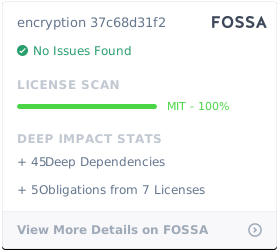
This package is freely distributable under the terms of the [MIT license](https://github.com/EMPO-dev/encryption/blob/master/LICENSE). When required, please check [P-H-C/phc-winner-argon2](https://github.com/P-H-C/phc-winner-argon2) for license over Argon2 and the reference implementation.
[](https://app.fossa.com/projects/git%2Bgithub.com%2FEMPO-dev%2Fencryption?ref=badge_large)