@arcgis/core
Version:
ArcGIS Maps SDK for JavaScript: A complete 2D and 3D mapping and data visualization API
133 lines (125 loc) • 5.59 kB
TypeScript
/**
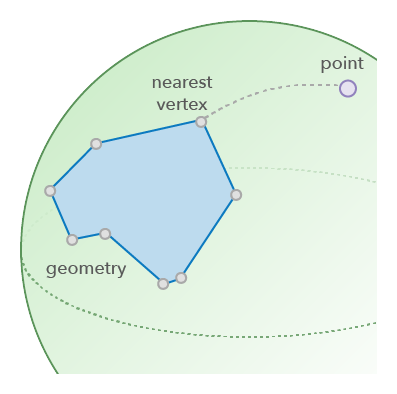
* Finds closest vertices of a 2D geometry using geodesic distance.
*
* > [!WARNING]
* >
* > **Notes**
* >
* > Verify that `isLoaded()` returns `true` before using this module.
* > Use `load()` to load this module's dependencies.
*
* 
*
* @since 4.31
*/
import type Point from "../Point.js";
import type { LengthUnit } from "../../core/units.js";
import type { GeometryUnion } from "../types.js";
import type { ProximityResult } from "./types.js";
export interface Options {
/**
* The length unit of the result distance.
*
* @default "meters"
*/
unit?: LengthUnit;
}
export interface GetNearestCoordinateOptions extends Options {
/**
* When the parameter is set to true, this function will calculate the left/right side of a polyline or polygon.
* Look for the result in the `isRightSide` property of the returned `ProximityResult` object.
*
* @default false
*/
calculateLeftRightSide?: boolean;
/**
* The value controls the error of calculation.
* The method uses shape preserving densification to approximate the input segments with great piecewise elliptical arcs.
* When the value is zero or NaN, internally the operator uses 0.01 meters.
* For other values, unless the `unit` option is set, the default is meters.
*
* @default NaN
*/
maxDeviation?: number;
/**
* When `geometry` is a polygon, the function will test if `point` is inside of the polygon.
* Points that are inside of the polygon have zero distance to the polygon.
* When set to `false`, the function will not check if the point is inside of the polygon, but will only determine proximity to the boundary.
*
* @default true
*/
testPolygonInterior?: boolean;
}
/**
* Indicates if all dependencies of this module have been loaded.
*
* @returns Returns `true` if this module's dependencies have been loaded.
*/
export function isLoaded(): boolean;
/**
* Loads this module's dependencies. This method must be called first if `isLoaded` returns `false`.
*
* @returns Resolves when the dependencies have been loaded.
* @see [isLoaded()](https://developers.arcgis.com/javascript/latest/references/core/geometry/operators/geodesicProximityOperator/#isLoaded)
*/
export function load(): Promise<void>;
/**
* Returns the nearest coordinate on the geometry to the given input point.
* The operator interprets all segments in the shape preserving manner, that is it treats segments as if they are densified with a small step in the input spatial reference and then the calculation is performed geodesicly.
*
* @param geometry - The input geometry.
* @param point - The point used to search for the nearest coordinate in `geometry`.
* @param options - Additional options.
* @returns Returns the result of proximity operation.
* @example
* if (!geodesicProximityOperator.isLoaded()) {
* await geodesicProximityOperator.load();
* }
*
* // Calculate the nearest coordinate on a polyline to the given point
* const result = geodesicProximityOperator.getNearestCoordinate(polyline, point);
*/
export function getNearestCoordinate(geometry: GeometryUnion, point: Point, options?: GetNearestCoordinateOptions): ProximityResult;
/**
* Returns the nearest vertex on the geometry.
*
* @param geometry - The input geometry.
* @param point - The point used to search for the nearest coordinate in the input `geometry`.
* @param options - Additional options.
* @returns Returns the result of proximity operation.
* @example
* if (!geodesicProximityOperator.isLoaded()) {
* await geodesicProximityOperator.load();
* }
*
* // Calculate the nearest vertex on a polyline to the given point
* const result = geodesicProximityOperator.getNearestVertex(polyline, point);
*/
export function getNearestVertex(geometry: GeometryUnion, point: Point, options?: Options): ProximityResult;
/**
* Returns vertices of the geometry that are closer to the given point than the given radius.
*
* @param geometry - The input geometry.
* @param point - The point used to search for the nearest coordinate in `geometry`.
* @param searchRadius - The distance to search from the `point` to the nearest vertices in the `geometry`.
* Unless the `unit` option is set, the default is meters.
* @param maxVertexCountToReturn - The maximum number of vertices that will be returned. Must be a positive number.
* @param options - Additional options.
* @returns The array of vertices that are in the given search radius to the point.
* The array is sorted by distance to the queryPoint with the closest point first.
* When there are more than the `maxVertexCountToReturn` vertices to return, it returns the closest vertices.
* The array will be empty when `geometry` is empty.
* @example
* if (!geodesicProximityOperator.isLoaded()) {
* await geodesicProximityOperator.load();
* }
*
* // Calculate the nearest vertices on a polyline to the given point
* const result = geodesicProximityOperator.getNearestVertices(polyline, point, 100, 5);
*/
export function getNearestVertices(geometry: GeometryUnion, point: Point, searchRadius: number, maxVertexCountToReturn: number, options?: Options): ProximityResult[];
/**
* Indicates if the operator supports input geometries that contain curves.
* The value is `null` or `undefined` until the operator is loaded, then it will always be `true`.
*/
export const supportsCurves: boolean | null | undefined;