@arcgis/core
Version:
ArcGIS Maps SDK for JavaScript: A complete 2D and 3D mapping and data visualization API
36 lines (33 loc) • 1.77 kB
TypeScript
/**
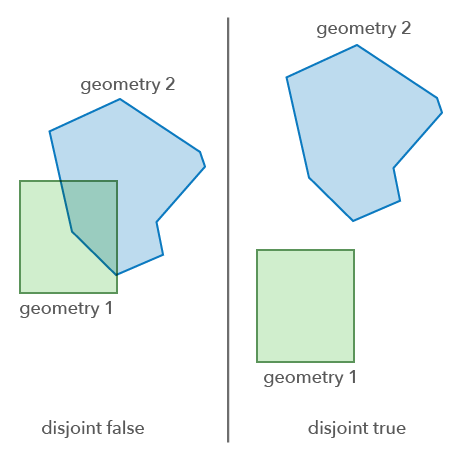
* Performs a relational operation to determine if one 2D geometry is disjoint (doesn't intersect in any way) with another 2D geometry.
* This operator can be used with non-simple geometries.
*
* 
*
* @since 4.31
*/
import type { GeometryUnion } from "../types.js";
/**
* Accelerate a geometry. This method prepares the geometry for faster disjoint operations when the same geometry is tested multiple times (e.g. in a loop with hundreds of iterations). See the [Acceleration](https://developers.arcgis.com/javascript/latest/spatial-analysis/intro-geometry-operators/#acceleration) guide topic for more information.
*
* @param geometry - The geometry to accelerate.
* @returns Returns `true` if the geometry was successfully accelerated.
*/
export function accelerateGeometry(geometry: GeometryUnion): boolean;
/**
* Perform a disjoint operation on two geometries.
*
* @param geometry1 - The base geometry that is tested for the "disjoint" relationship with `geometry2`.
* @param geometry2 - The comparison geometry that is tested for the "disjoint" relationship with `geometry1`.
* @returns Returns `true` if `geometry1` and `geometry2` are disjoint (don't intersect in any way).
* @example
* // Returns true if a geometry is not contained in another.
* // Operates the opposite of contains.
* const isDisjointed = disjointOperator.execute(polygon1, polygon2);
*/
export function execute(geometry1: GeometryUnion, geometry2: GeometryUnion): boolean;
/**
* Indicates if the operator supports input geometries that contain curves.
* The value will always be `true`.
*/
export const supportsCurves: boolean;