@arcgis/core
Version:
ArcGIS Maps SDK for JavaScript: A complete 2D and 3D mapping and data visualization API
95 lines (91 loc) • 5.05 kB
TypeScript
/**
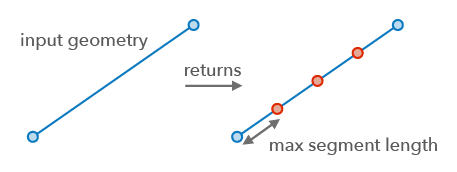
* Densifies 2D geometries by length, deviation and/or angle in a 2D plane. The result geometry contains segments less than or equal to `maxSegementLength`, and it will not contain curves.
* The piecewise approximation of curves will be within the specified deviation from the original curve,
* and the angle between tangent segments does not exceed the specified value.
*
* If `maxAngleInDegrees` is not zero, vertices are added at points along the curve where the angle between tangent segments reaches this value.
* These vertices are then connected by straight-line segments.
*
* If `maxSegmentLength` is zero, only curves are affected and other geometries remain unchanged.
* The process always starts from the highest point on a segment, so equal segments will be densified in the same way.
*
* When the `maxSegmentLength`, `maxDeviation`, and `maxAngleInDegrees` parameters are all set to `0`,
* curves are replaced with the line segments connecting the curve endpoints.
*
* Suggestion: to limit the number of segments that are produced, if you have an area of interest such as a visible extent,
* clip the input geometries before densifying.
*
* 
*
* @since 4.31
*/
import type { LengthUnit } from "../../core/units.js";
import type { GeometryUnion, GeometryWithoutMeshUnion } from "../types.js";
export interface Options {
/**
* The maximum angle allowed for densification by angle. The number must be greater than or equal to zero and is only applicable on curves. The default value of `0` disables densification by angle. The value will be capped at 90 degrees (π/2). This specifies the maximum angle that a new vertex can deviate from the original geometry.
*
* @default 0
*/
maxAngleInDegrees?: number;
/**
* The maximum distance a newly placed vertex on a densified polyline can deviate from the original location on the curve.
* The number must be greater than or equal to zero. Applicable only on curves.
* The default of passing `0` disables densification by deviation.
* Unless the `unit` option is set, the default is the geometry's spatial reference unit.
*
* @default 0
*/
maxDeviation?: number;
/**
* The length unit of `maxSegmentLength` and `maxDeviation`.
* The default is the input geometry's spatial reference unit.
* An error will be thrown if this is set for Geographic Coordinate Systems.
*/
unit?: LengthUnit;
}
/**
* Performs the densify operation on the geometry.
*
* @param geometry - The geometry to be densified.
* @param maxSegmentLength - The maximum distance between vertices when the input geometry is densified.
* The number must be greater than or equal to zero.
*
* When the parameter is set to `0`, this operation only applies to curves and disables densification by length.
* Curves are densified to straight segments using the given length.
* And, curves are split into shorter subcurves such that the length of subcurves is shorter than `maxSegmentLength`.
* After that the curves are replaced with straight segments.
* Unless the `unit` option is set, the default is the spatial reference unit of `geometry`.
* @param options - Additional options.
* @returns Returns the densified geometry that does not contain any curves.
* @example
* // Returns a densified polyline.
* const densified = densifyOperator.execute(polyline, 100);
* @example
* // Returns a polyline where all curve segments have been densified.
* if (polyline.curvePaths) {
* const densified = densifyOperator.execute(polyline, 0, { maxAngleInDegrees: 1 });
* }
*/
export function execute(geometry: GeometryUnion, maxSegmentLength: number, options?: Options): GeometryWithoutMeshUnion;
/**
* Performs the Densify operation on the geometry set.
*
* @param geometries - The set of geometries to be densified.
* All the geometries must have the same spatial reference.
* @param maxSegmentLength - The maximum segment length allowed. The number must be greater than or equal to zero.
*
* When the parameter is set to `0`, this operation only applies to curves and disables densification by length.
* Curves are densified to straight segments using the given length.
* And, curves are split into shorter subcurves such that the length of subcurves is shorter than `maxSegmentLength`.
* After that the curves are replaced with straight segments.
* Unless the `unit` option is set, the default is the geometries spatial reference unit.
* @param options - Additional options.
* @returns Returns the densified geometries that do not contain any curves.
*/
export function executeMany(geometries: GeometryUnion[], maxSegmentLength: number, options?: Options): GeometryWithoutMeshUnion[];
/**
* Indicates if the operator supports input geometries that contain curves.
* The value will always be `true`. This will produce densified output geometries.
*/
export const supportsCurves: boolean;